
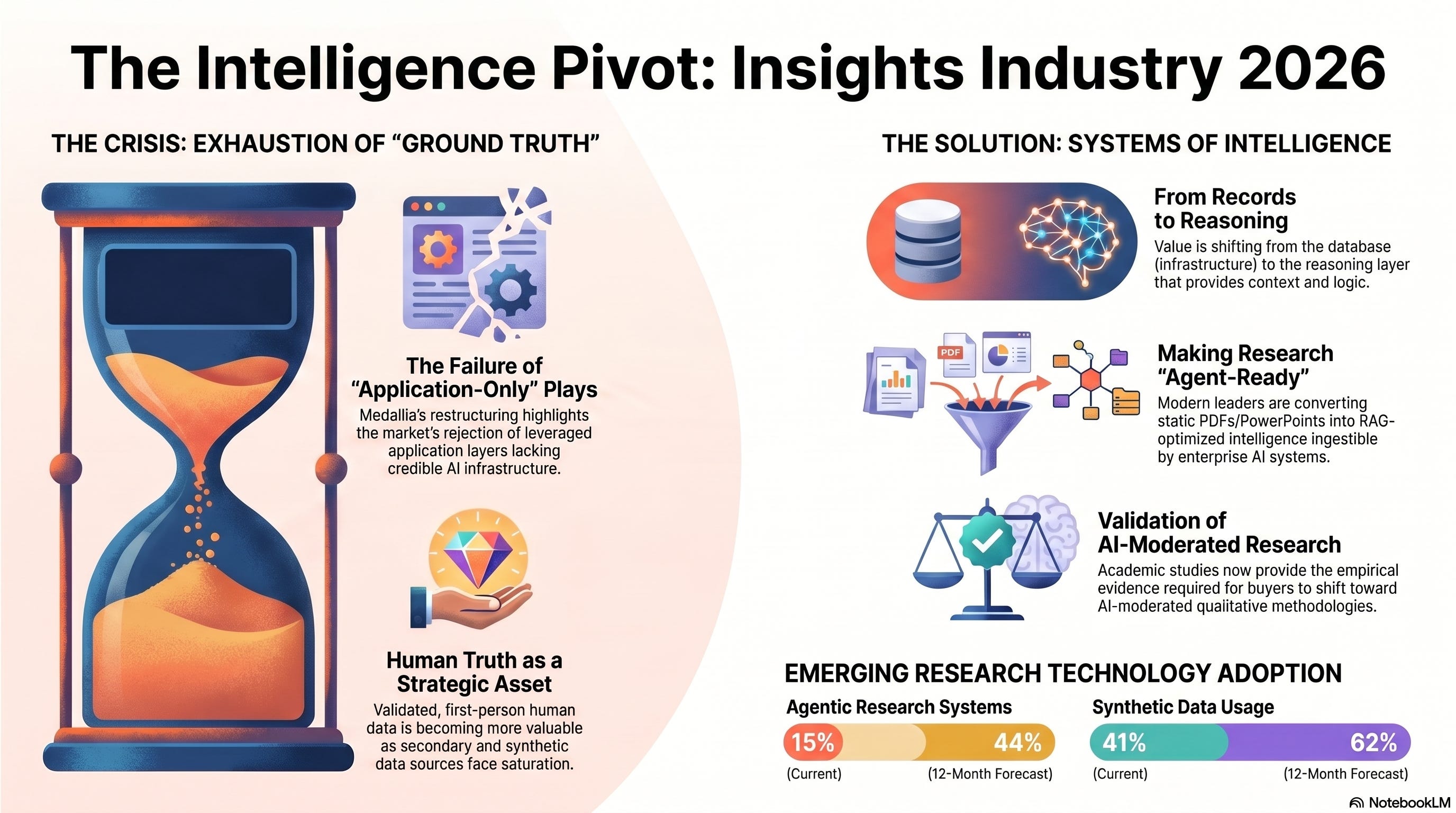
This week arrived with a deceptively quiet surface and a loud underlying current. Three themes crystallized with unusual sharpness: the “system of intelligence” architecture is being built in real time across both Big Tech and the insights industry itself, ground truth data is being recognized as an existential supply constraint for AI, and Medallia’s collapse into creditor hands closes the loop on the Cint/Medallia comparative thesis we introduced April 30 and continued in last week’s edition. Beneath all of it runs the same question: who owns the reasoning layer above the data, and who gets disintermediated because they answered that question too late?
By the way, if you want to hear IIV GP Lenny Murphy discuss some of these trends and a subset of the news with Karen Lynch of Greenbook, every Friday at 12 ET he does a live webcast for Greenbook called The Exchange; you can tune in here.
Funding, M&A and the Capital Stack
Uncertain Future for Medallia After Debts Mount
The restructuring is complete. Thoma Bravo has ceded control of Medallia to a group of lenders led by Blackstone, which holds a significant share of the $2.8B in outstanding debt, after the PIK relief window expired and the firm declined to inject further equity. This wipes out roughly $5.1 billion in equity on a $6.4B take-private done in 2021. Medallia’s annual debt service had climbed to approximately $300M against roughly $200M in annual earnings. The math simply did not work, and the AI environment made the path to re-rating the business nearly impossible.
We have been calling this since April. The Cint vs. Medallia frame we introduced in the April 30th edition continues to be useful because it captures the dynamic precisely: Cint is leaning into the infrastructure role and is building the data asset volume to meet the AI era ; Medallia stayed “experience management application” too long, ran the leverage playbook past its expiration date, and got repriced. The lender takeover does not mean Medallia disappears. Blackstone, KKR, Apollo, and Antares are not charity organizations. But it does mean the company will be restructured around what actually generates defensible cash flow, and the path to any recovery requires answering the infrastructure-vs.-application question that management and the prior sponsor avoided. SaaStr has a useful read on which other PE-backed SaaS deals may be next in line.
Throughline: The Medallia resolution is the clearest data point yet that the market is not being patient with PE-backed, leveraged application plays without credible AI infrastructure stories. Investors who have not run the Cint/Medallia lens across their portfolios should do so immediately. As we argued in How Private Equity Will Rebuild the Insights Industry, the next version of value creation in this category belongs to companies that are infrastructure-adjacent, not just well-leveraged application stacks. Medallia is the closing argument for that thesis.
The Ground Truth Problem: AI’s Coming Supply Crisis
Lisa Lovallo Ceppos at OpenAI: “We May Run Out of Ground Truth Data by 2030”
The most important insight of the week did not come from a research vendor; it came from a question asked at an OpenAI event. Lisa Lovallo Ceppos asked Sam Altman and Sarah Friar directly: what happens to AI models when there is no training data left? The estimates suggest we exhaust global ground truth data supply somewhere around 2030. This is not a rhetorical concern; it is an engineering constraint with a known timeline.
The implications for the insights industry are direct and profound. Primary research has always sold itself as “access to human truth.” For a generation, that value proposition was under pressure from secondary data, synthetic data, and passive behavioral data. Now those pressures are converging with an active supply deficit that makes the industry’s core product, structured, validated, first-person human data, more strategically valuable than it has been in decades. The question is whether the industry will recognize and monetize that value before the hyperscalers route around it.
a16z: “From System of Record to System of Intelligence”
An Andreessen Horowitz piece this week makes the structural argument explicit: the reasoning layer that sits above the database, which treats the database as infrastructure, is where a new generation of companies is being built. Systems of record (CRMs, ERPs, survey platforms) are becoming infrastructure. The premium moves to whoever owns the context and reasoning layer above them. This is the logical architecture for what “ground truth as a strategic asset” actually means in practice.
a16z: “Is Software Losing Its Head?”
A companion piece from a16z argues that agents may kill muscle memory as a moat, but they do not kill operational logic and context as a moat. The UI is dying; the knowledge and reasoning layer underneath it is not. For research platforms built around proprietary panels, longitudinal data, or validated methodologies, this is the frame: your interface is disposable, your data and logic are not.
Throughline: The ground truth supply crisis and the shift from system-of-record to system-of-intelligence are the same story told from two directions. Primary research firms that treat their data assets as commodity inputs are making a dangerous strategic error. Those assets are becoming the raw material that frontier AI will pay for, if the industry learns to package and position them correctly. We have been building toward this argument for months across this series, and this week it arrived with independent corroboration from the lab building the models that will need that data most.
Agents Go Mainstream Across the Industry
YouGov Expands AI Agent Across the Full Crunch Platform
YouGov has rolled out its AI Agent functionality across the entire Crunch platform, making every dataset in its ecosystem (custom research, syndicated tracking, YouGov Profiles+, CategoryView) explorable via natural language conversation. The full 30+ million member panel is now queryable through conversational questions with instant, validated responses. Clients retain folder-level control over AI Agent access. This is not a feature update. This is YouGov repositioning its data estate as a conversational intelligence layer rather than a portal you log into.
The Harris Poll Launches AI-Ready Research Packet with NeuIQ
Harris Poll (Stagwell) and NeuIQ have introduced a first-of-its-kind offering: traditional research deliverables (PDFs, PowerPoints, Excel cross-tabs) converted into structured, governed, RAG-optimized intelligence that enterprise clients can ingest directly into their own AI systems. No reformatting required, no new system adoption. The research output becomes a plug-in component for the client’s existing AI infrastructure. This is the most direct product-market manifestation of the “system of intelligence” thesis we have seen from a traditional research firm.
Stagwell’s BERA Adds Brand-to-Business AI Agent
Stagwell has upgraded its BERA predictive brand platform with a rapid brand impact reporting service called the Brand-to-Business AI Agent, part of its Marketing Cloud and Harris Poll offerings. The agent converts brand performance signals into business impact reporting, closing the loop between the brand measurement layer and the business decision layer in a single automated workflow.
Tableau Unveils Agentic Analytics Platform
Salesforce’s Tableau launched an Agentic Analytics Platform built on six pillars: Knowledge Engine, Conversational Analytics, Headless Analytics via open MCP server, Decision Engine, Command Center, and Security. The Knowledge Engine draws on 33 million semantic models built over a decade by Tableau users. The MCP server delivers insights directly into Slack, Teams, Claude, and ChatGPT. The Decision Engine triggers workflows from analysis; a Salesforce case opens automatically when CSAT scores drop below a threshold. This is what “system of intelligence” looks like when a major platform commits to the architecture fully.
Throughline: YouGov, Harris Poll/NeuIQ, Stagwell/BERA, and Tableau are converging on the same blueprint: make data and analysis consumable by agents, not just humans. The interface is becoming the API. The value is in the knowledge and reasoning layer, not the portal or the PDF. In the framing we have used since the April 30 Cint/Medallia edition and sharpened in last week’s piece on decision infrastructure, these moves are companies choosing which side of the Cint/Medallia divide they want to be on. Companies still delivering research as static documents are not just behind on UX; they are structurally misaligned with where enterprise AI is being built.
New Product Launches and Platform Moves
Norstat Launches Expert Network for Verified B2B Audiences
Norstat has formalized its B2B research offer with the launch of Norstat Expert Network, providing clients access to verified senior business decision-makers (CFOs, IT leads, category managers, security specialists) across 22 countries for surveys, expert interviews, and focus groups. Expert network infrastructure at scale and with geographic reach is exactly the kind of trust moat we have been flagging: hard to replicate, high-verification, and resistant to synthetic substitution.
Okay Human Launches Behaviorally-Triggered Qualitative Research
Okay Human, now part of newly-formed agency DigitalMYnd, has announced real-time behavioral trigger-based survey and qual tools that reach respondents at the moment of a decision rather than retrospectively. This is the in-context, in-moment research architecture that addresses one of the core criticisms of traditional survey research: by the time you ask, the respondent has rationalized. Getting there while the decision is still forming is a different product with a different validity profile.
aytm Relaunches Lighthouse Academy with AI Learning Pal
US research platform aytm has relaunched its online learning platform Lighthouse Academy with a new AI-powered conversational learning agent called the Learning Pal. Upskilling infrastructure is not glamorous news, but in an environment where MRII found the industry “optimistic but not yet ready” for AI-native workflows, building the learning layer into the platform itself is a defensible and underrated move.
Mintel and Dragonfly AI Partner on Packaging Intelligence
Mintel has integrated Dragonfly AI’s predictive attention intelligence into its Global New Products Database (GNPD), giving every product entry a packaging performance score based on how the human brain processes visual content. Clients can now predict packaging performance pre-launch against category benchmarks. Dragonfly’s neuroscience technology was developed in partnership with Queen Mary University of London. This is a direct answer to the “decision infrastructure” demand: turning GNPD from a product database into a predictive packaging performance engine.
OpenAP Standardized Attribution Across Linear and Streaming TV
Nine major US broadcasters and publishers have launched a new standardized attribution initiative in partnership with OpenAP, promising advertisers a consistent way to connect first-party outcome data to campaign exposure data across linear and streaming TV. Cross-platform measurement standardization is one of the most intractable problems in media analytics; a nine-publisher consortium committing to shared architecture is a meaningful structural move.
Kristi Zuhlke Launches Claude Cowork Series for Insights Professionals
KnowledgeHound’s Kristi Zuhlke is publishing a 5-part series on using Claude Cowork for insights work, covering setup, turning survey data into stakeholder decks, and building automated competitive intel. The fact that a respected practitioner with deep survey and insights credentials is building a public curriculum around Claude Cowork tells you something about where the practitioner toolset is actually landing: not just AI in research platforms, but AI as the research platform.
Throughline: The common denominator across all of these launches is specificity. Norstat’s verified B2B expert network, Okay Human’s behavioral triggers, Mintel/Dragonfly’s packaging attention scores, and Harris Poll’s AI-ready packets are all domain-specific, not generic. Each builds a moat from precision and trust, not from breadth. Zuhlke’s Claude Cowork series sits at the practitioner level but points in the same direction: the value is in knowing exactly what to do with the tools, not just having access to them. Horizontal AI tools commoditize fast; vertical AI with domain context and workflow integration builds moats. Every insights supplier building a generic “AI-powered research platform” without a specific domain wedge is building on quicksand.
Big Tech and the Architecture of What Comes Next
OpenAI Launches the Deployment Company (DeployCo)
OpenAI has launched DeployCo, a new enterprise deployment vehicle described as a $10 billion JV majority-owned by OpenAI, designed to help large organizations move frontier AI from experimentation to production. This follows the PE-backed JV model we covered last week with Anthropic’s similar move. The pattern is now a confirmed strategy: frontier model labs are not waiting for traditional consulting and SI channels to evolve. They are building their own deployment infrastructure, and they are capitalizing it at the utility-asset level. Every insights supplier that was counting on “we’ll build AI capabilities eventually” now has a very well-funded competitor offering to do it for their clients directly.
Mira Murati’s Thinking Machines: “Interaction Models”
Murati’s new company is showing off something it calls “interaction models”: AI systems designed to engage in sustained, adaptive, multi-turn interactions rather than single-shot responses. The implications for research are clear; if interaction models can conduct nuanced, context-aware, multi-session engagements with subjects, the methodology question is no longer “can AI do qual” but “is AI-moderated qual becoming the default infrastructure?”
Qualtrics: Agentic AI Is Rebuilding Market Research
Ali Henriques at Qualtrics offers a pointed industry diagnosis: market researchers are being squeezed from both sides, businesses moving faster than research can deliver, and AI absorbing the tasks that defined researcher value. Her data: adoption of agentic research systems is set to nearly triple from 15% to 44% in the next 6 to 12 months; synthetic data usage will jump from 41% to 62%. The framing, “we’re moving from research as a project to research as an always-on intelligence system,” is accurate. Whether Qualtrics specifically is positioned to lead that shift is a separate question, one we examined in depth in The Qualtrics Canary earlier this year.
CB Insights AI 100 for 2026
The CB Insights AI 100 is worth scanning for signal on where capital and innovation are concentrating. The most interesting pattern for our world: vertical AI agents with proprietary domain data are better represented than horizontal tool plays, which aligns directly with the “go vertical” thesis above.
Figure Humanoid Robots: From One Per Day to One Per Hour
Figure has scaled production of its O3 humanoid robot from one unit per day to one per hour at its California BotQ facility, with two robots now cleaning and organizing a bedroom in coordinated tasks in under two minutes. This matters for insights because humanoid robots at scale are both behavioral data generators and behavioral data subjects; the industries that will grow up around monitoring, insuring, and optimizing them will need exactly the kinds of always-on behavioral intelligence infrastructure that we are now calling “agentic research.”
MCP and Skills Marketplaces: The Next Layer
Unitree has launched UNISTORE, an app store for humanoid robots where you can create, publish, buy, and deploy robot skills with one click across their models. And Greg Isenberg’s widely shared 30-plus observations on AI agent opportunities makes the framing explicit: the new buyer on the internet is an AI agent, and the new commerce layer runs on MCP. The insights firm that builds MCP-accessible, agent-purchasable research capabilities early will own a toll position that does not exist yet but is being constructed in real time.
AdClarity and Adthena Race to Own ChatGPT Ad Intelligence
Both BIScience’s AdClarity and Adthena have launched ChatGPT advertising intelligence platforms within days of each other. ChatGPT is now a significant ad channel, and two competing platforms are racing to be the measurement infrastructure for it. This is search measurement 2.0: whoever establishes the canonical data layer for AI-channel ad performance owns a durable asset.
Throughline: DeployCo, Thinking Machines’ interaction models, the LSE study, Tableau’s agentic stack, Figure’s humanoid production ramp, and the emerging MCP/skills marketplace layer are not separate stories; they are the same architecture being built at different layers of the stack simultaneously. The speed at which AI is moving from experiment to industrial-scale infrastructure is no longer a forecast. It is observable in production volumes, capital commitments, and academic publications this week alone. For the insights industry, the question is not whether to engage with this architecture but how quickly you can find your defensible position within it before the construction is complete.
Interesting Reading
“Go Vertical or Get F*&ked: How Not to Lose Your Job in the Age of AI”
Hamish Brocklebank’s piece captures the competitive logic precisely: horizontal AI tools commoditize fast; vertical AI with domain context and workflow integration builds moats. It also covers how companies should actually be deploying AI rather than just procuring it.
“Is Software Losing Its Head?” (a16z)
The reasoning behind why the UX layer is being hollowed out while the operational logic underneath gains value. Essential reading for understanding what “defensible moat” means in an agent-first world.
“From System of Record to System of Intelligence” (a16z)
The companion piece that explains where the next generation of valuable companies is being built: the reasoning layer above the database, treating the database as infrastructure.
LSE: The Strongest Empirical Case Yet for AI-Moderated Research
Friedrich Geiecke and Xavier Jaravel at the London School of Economics have published the most rigorous empirical study to date on AI-led qualitative interviewing, running five large-scale studies across four domains with five different LLMs (three proprietary, two open source), validating voice mode, and releasing an open-source deployment platform. This is no longer a theoretical discussion. Academic-grade validation of AI moderation changes the procurement conversation: buyers now have independent evidence to justify the shift, and suppliers who have not built AI-moderated capabilities are on notice.
Gen Z and Agentic Commerce: Snap/Alter Agents/Omnicom Research on 13-18 Year Olds
New research from Snap, Alter Agents, and Omnicom Media on how the next generation navigates relationships, content, and technology is useful context for anyone thinking about what agentic commerce actually looks like from the demand side. The cohort that will normalize AI-agent-mediated purchasing is already 13 to 18 years old.
Throughline: The reading list this week forms a coherent syllabus on a single question: where does value accrue when AI absorbs the interface layer? The a16z pair answers it at the architecture level (the reasoning layer above the data), the LSE study answers it at the methodology level (AI-moderated qual is now academically validated), Hamish answers it at the competitive strategy level (go vertical or lose), and the Snap gen-Z study answers it at the demand side (the buyers normalizing AI-mediated commerce are already a defined, reachable cohort). Read them together and the picture is unusually clear.
Big Idea of the Week
The reasoning layer is the new battleground, and primary research owns the raw material.
The convergence this week is sharp: a16z articulates the shift from system-of-record to system-of-intelligence; Harris Poll and YouGov build the first practical implementations of research-as-AI-input; Tableau ships the agentic analytics stack; and a credible academic study validates AI-moderated qual. Meanwhile, the ground truth supply crisis that Lisa Lovallo Ceppos surfaced at OpenAI suggests the industry’s core product, human truth validated and at scale, is becoming structurally scarce in the AI economy.
The Medallia outcome closes the argument we have been making since early this year: the market does not reward leveraged applications that ride on borrowed data and deferred AI roadmaps. It rewards infrastructure, trust moats, and reasoning layers with proprietary context. For suppliers, this week’s news provides both the threat (DeployCo, Thinking Machines, Tableau agents) and the playbook (Harris Poll/NeuIQ, YouGov Crunch, Norstat Expert Network, Mintel/Dragonfly). The question is who has the clarity and the capital to execute before the window narrows further.
Implications for Suppliers
1. Build the AI-input layer, not just the AI-output layer.
Harris Poll’s AI-Ready Research Packet and YouGov’s conversational Crunch agent are both solving the same problem: making research outputs directly consumable by enterprise AI systems. Every research firm should be asking: can our deliverables plug into a client’s RAG environment today? If not, you are not on the roadmap; you are a vendor waiting to be replaced by one that is.
2. Your domain data is more valuable than your platform.
The ground truth supply crisis makes this explicit. Proprietary panels, longitudinal trackers, expert networks, and behavioral data assets are the scarce inputs that AI systems will need and cannot synthesize. Stop burying those assets in subscription portals and start packaging them as AI-ready data products with APIs, governance frameworks, and agent-readable contracts.
3. Vertical depth beats horizontal breadth every time right now.
The CB Insights AI 100, the “go vertical” argument, and the Thinking Machines “interaction model” thesis all point in the same direction: domain-specific AI with context and workflow integration outcompetes generic AI in procurement decisions. Define your vertical, own your workflow position, and stop trying to be an all-purpose insights platform.
4. AI-moderated methods are no longer experimental; they are table stakes.
The LSE study closes the academic debate. Buyers now have independent evidence to justify AI-moderated qual. Suppliers without a credible AI moderation story are not just behind the innovation curve; they are behind the procurement curve.
Implications for Buyers
1. Demand AI-ready outputs from every research vendor.
Harris Poll’s AI-Ready Research Packet shows this is buildable and deployable now. Every RFP and contract renewal should include a requirement for structured, RAG-optimized research outputs. If a vendor cannot deliver research that plugs into your AI infrastructure, you are paying for data you cannot fully use.
2. Treat ground truth data as a strategic supply chain input.
The 2030 supply constraint Lisa Lovallo Ceppos raised is not a vendor’s problem; it is your problem. Start mapping which of your insight partners own genuine human truth at scale (longitudinal panels, expert networks, behavioral data) versus those who rely on synthetic augmentation. Build relationships and contracts around the former before scarcity drives up prices.
3. Evaluate analytics platforms on their agentic architecture, not their dashboards.
Tableau’s six-pillar Agentic Analytics Platform is the model: Knowledge Engine, Decision Engine, MCP-accessible headless analytics. Evaluate every analytics tool against this architecture. Portals and dashboards are not the end state; platforms that agents can call programmatically are.
Implications for Investors
1. Medallia is the last warning, not the first.
The equity wipeout is the clearest market signal yet that leveraged, application-layer plays without AI infrastructure stories will be restructured, not refinanced. Run the screen: which portfolio companies look more like Medallia than Cint? The time to act is before the PIK window closes.
2. The AI-ready data infrastructure play is underpriced.
Harris Poll/NeuIQ, Norstat’s Expert Network, and the ground truth supply story all point to the same investment thesis: companies that own validated, structured, domain-specific human data at scale and can deliver it in AI-ready formats are sitting on assets that will be worth significantly more as the ground truth constraint bites. That thesis is not yet reflected in most M&A multiples in the research sector.
3. Watch the MCP and skills marketplace layer.
The Unitree UNISTORE launch and Isenberg’s AI-agents-as-buyers thesis both point to the same emerging infrastructure layer: MCP and skills marketplaces where agents discover, purchase, and deploy capabilities. The insights firm that builds MCP-accessible, agent-purchasable research capabilities early will own a toll position that does not yet exist but is being constructed in real time.