
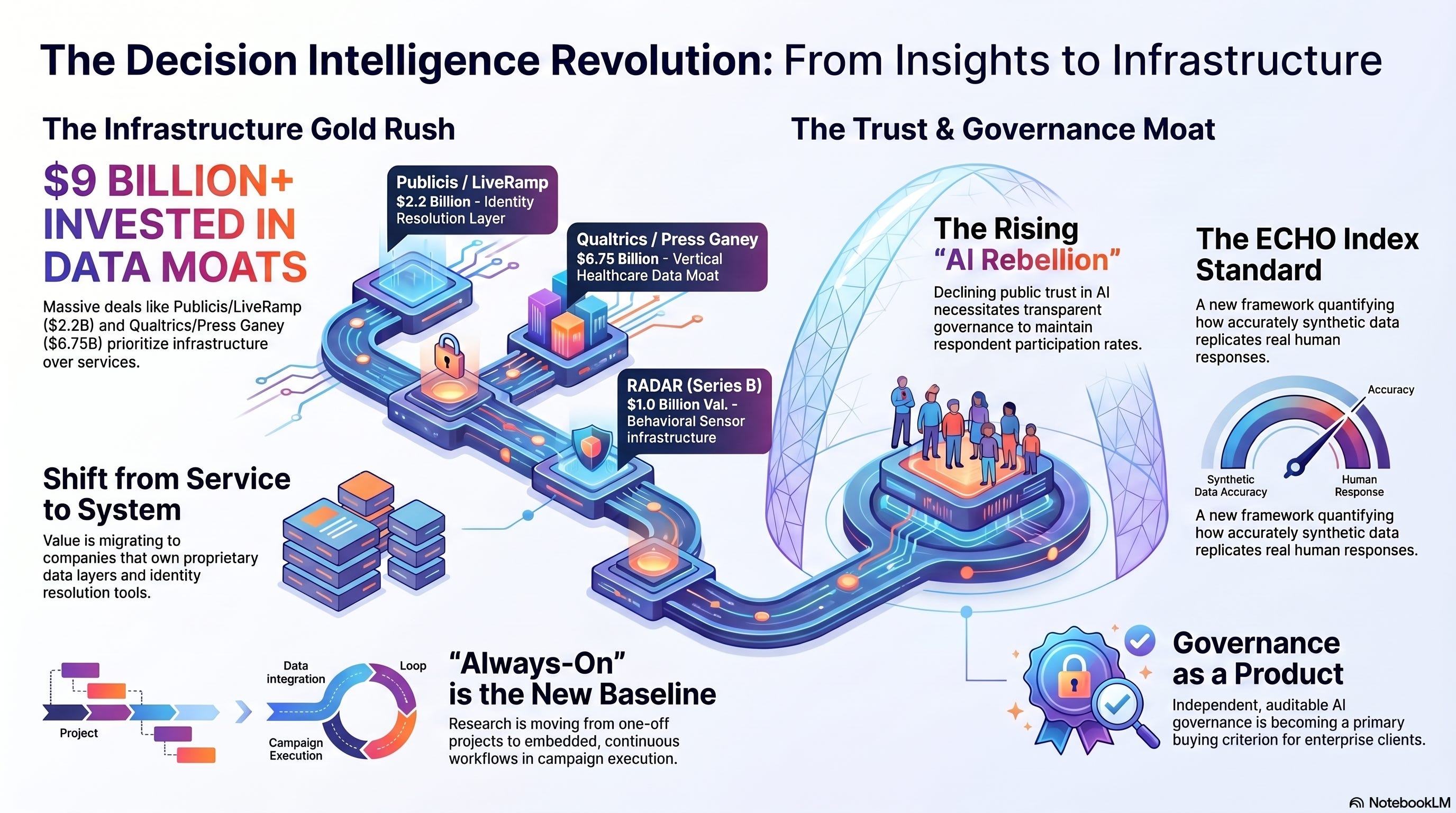
This week delivered two of the largest deals the insights and analytics adjacent space has seen in years, a cascade of product launches that advance the synthetic data governance conversation, a sobering public sentiment signal that most of the industry is ignoring, and a structural tech argument that rewrites the economics of building software. In other words, just another average week in the brave new world we find ourselves in!
The dominant theme is consolidation of data infrastructure at the top of the stack, with Publicis/LiveRamp and Qualtrics/Press Ganey Forsta as exhibit A and exhibit B, respectively; and simultaneously, a wave of product moves lower in the stack that are building the governance and quality rails that AI-native research requires. The Jevons Paradox thesis we published last week (here) lands with fresh force this week: cheap AI has not shrunk demand for intelligence infrastructure; it has exploded it, and the capital allocation now confirms it.
By the way, if you want to hear IIV GP Lenny Murphy discuss some of these trends and a subset of the news with Karen Lynch of Greenbook, every Friday at 12 ET he does a live webcast for Greenbook called The Exchange; you can tune in here.
Funding, M&A and the Capital Stack
Publicis Acquires LiveRamp for $2.2 Billion
The week’s most consequential deal for the broader data and insights ecosystem: Publicis Groupe has agreed to acquire LiveRamp for a total enterprise value of $2.167 billion in cash, a nearly 30% premium to the prior closing price. Publicis has been on a deliberate infrastructure acquisition strategy for years (Epsilon, Sapient, Profitero), and this is the capstone move: LiveRamp is not a media buying tool or a creative shop; it is the identity resolution and data collaboration layer that the entire adtech ecosystem runs on. Rival agency networks now face an uncomfortable choice: continue to use a data infrastructure layer now owned by their primary competitor, or find alternatives that do not yet exist at comparable scale.
Publicis has promised LiveRamp will remain a “neutral, interoperable platform with open access across the ecosystem.” As The Current reports, the industry is not buying it. Nor should it. Structural neutrality is economically unstable once ownership changes hands and incentives diverge. The more useful frame, articulated well by Ivan Fernandes on LinkedIn, is that this is not a HoldCo move; it is an Accenture move. Publicis is not buying media leverage: it is buying infrastructure leverage, the kind that makes it the indispensable operating layer for clients who want to activate data across media, commerce, and experience simultaneously. If you want to dive deeper into this deal, we posted a more substantive analysis about it earlier this week here.
Qualtrics Acquires Press Ganey Forsta for $6.75 Billion
Qualtrics has completed its acquisition of Press Ganey Forsta for $6.75 billion, combining decades of proprietary healthcare experience data and regulatory systems with the Qualtrics XM platform. We telegraphed this deal in The Qualtrics Canary in March; the completion validates the thesis that Qualtrics’ path under Silver Lake is a vertical data asset accumulation strategy, not a horizontal platform play. Healthcare experience data is one of the most regulated, most defensible, and most clinically relevant data assets in the economy. The combination gives Qualtrics a vertical moat that is genuinely hard to replicate; the question remains whether the integration can be executed at this scale without fragmenting the platform.
RADAR Raises $170M Series B at $1B Valuation
Retail intelligence platform RADAR has raised $170M in Series B funding at a $1B valuation, led by Gideon Strategic and Nimble Partners. RADAR uses RFID sensors and proprietary machine learning to track inventory in real time across retail stores, scaling to act on that data (locate items, identify shrinkage, trigger replenishment) rather than just report it. This is exactly the “behavioral data as infrastructure” investment thesis: not a survey, not a panel, not a dashboard; a sensor network that generates continuous, unmediated ground truth about physical retail behavior, and translates it into action in the same workflow.
Ideally Acquires AI Startup Aether
Research platform Ideally has acquired Aether, a New Zealand AI startup that converts raw research data and institutional knowledge into finished, on-brand presentations. This is a “last mile” acquisition: Ideally already delivers fast consumer intelligence; Aether collapses the gap between insight and action by eliminating the manual reformatting step between data and stakeholder-ready deliverable. It is a small deal with a tight strategic logic: every step of friction between insight and decision is a place where research value leaks. Remove it.
Throughline: Three of the four deals this week, Publicis/LiveRamp, Qualtrics/Press Ganey Forsta, and RADAR, are bets on proprietary data at the infrastructure layer, not on software features or service delivery. Publicis is buying the identity resolution layer; Qualtrics is buying a healthcare data moat; RADAR is building a physical-world behavioral intelligence layer. The Ideally/Aether acquisition adds a fourth vector: the “last mile” between insight and activated decision. The pattern we have been tracking since How Private Equity Will Rebuild the Insights Industry is not a forecast anymore; it is the active deal flow. Capital is moving to companies that own data infrastructure and activation layers, not to those that only deliver research as a service.
Synthetic Data: From Promise to Governance Infrastructure
KS&R Introduces the ECHO Index
US-based strategic consultancy KS&R has launched the ECHO Index, a new evaluation framework that uses statistical and machine learning techniques to benchmark how well synthetic data performs against real human responses. Unveiled at the 2026 Sawtooth Research Conference in Berlin, the Index produces a single interpretable score that quantifies confidence in any synthetic model. The name is intentional: like an echo, synthetic data must start with something real and preserve the characteristics from which it was generated.
Bain: “Synthetic Customers Earn Their Stripes”
Bain’s new piece on synthetic customers is the most credible mainstream validation of the use case to date. The argument: when synthetic customers are grounded in proprietary first-party behavioral and voice-of-customer data, they can replicate up to 90% of key results from real survey and conjoint studies. The use case is augmentation and early-stage concept screening, not replacement of primary research. The ground truth supply constraint Lisa Lovallo Ceppos raised two weeks ago (May 15 edition) now has a Bain-endorsed use case attached to it: the smarter the synthetic augmentation, and the more governed the process, the more useful the extension of real data becomes.
Throughline: KS&R’s ECHO Index and the Bain synthetic customers piece are arriving at the same moment for a reason. The synthetic data debate has moved from “is it valid?” to “how do we govern it rigorously enough to use it with confidence?” That is the right question, and it represents genuine intellectual maturation in the industry. The ECHO Index is particularly notable because it comes from a service firm, not a platform vendor: KS&R is building governance infrastructure as a competitive moat rather than waiting for platform vendors to solve it for them. As we argued in the Jevons Paradox post last week, trust and quality infrastructure is one of the few durable control points in an AI-abundant world. KS&R just built a tangible artifact of that moat.
New Product Launches and Platform Moves
Bolt Insight Launches Bolt Intelligence
AI-moderated research firm Bolt Insight has launched Bolt Intelligence, an always-on consumer intelligence platform that integrates AI-moderated IDIs, online ethnography, MaxDiff, brand health trackers, UX concept testing, and large-scale quantitative studies in a single workflow. Social listening is also included. This is the end-to-end “research operating system” architecture in its most complete current form from a mid-size player: not a single-method tool, not a modular suite of disconnected features, but a unified platform where qual, quant, UX, and passive listening feed a single intelligence layer.
Guidepoint Repositions as AI-Powered Expert Access Platform
Expert network Guidepoint has announced a strategic repositioning from pure expert network to a broader AI-powered real-time knowledge access platform, adding AskGp (AI-assisted search and synthesis across expert content with source-cited answers), expanded content libraries, and faster answer workflows. This follows Norstat’s Expert Network launch last week and signals that the expert network category broadly is converging on the same architecture: human expert access plus AI synthesis layer plus instant delivery.
i-Genie Launches Impact IQ Online Engagement Tracker
i-Genie.ai has launched Impact IQ, which tracks social media conversations and search patterns to help brands understand how digital marketing investments drive online engagement, presented through a dashboard and the firm’s agentic interface Presto. Another behavioral passive-data product that sits at the intersection of social intelligence and marketing measurement.
Cint and illumin Partner on Real-Time Brand Measurement in Programmatic
Cint and illumin have announced a partnership that embeds Cint’s brand measurement capability directly into programmatic advertising workflows via the illumin platform, making brand lift measurement immediate and actionable within a campaign execution cycle rather than as a post-campaign add-on. This is Cint executing on its infrastructure thesis in the most direct possible way: not just a research panel, but a measurement layer that plugs into where ad decisions are actually made.
Sprinklr Launches the Social Index
Sprinklr has launched the Social Index, a new benchmark framework for how brands perform in social media moments that matter. Social intelligence as a structured, benchmarked, ongoing measurement system (rather than a one-off listening project) continues to advance as a category.
OASIS Launches Single Name Space Technical Committee
OASIS has launched a new technical committee with IBM, Guardant, DDN, and others to standardize universal cross-platform data access through a Single Name Space architecture. This is infrastructure plumbing but it matters: standardized data access layers are the rails on which agentic systems will retrieve and act on enterprise data. The insights industry’s ability to make research data agent-accessible depends on exactly this kind of foundational standardization.
Throughline: The new product and partnership moves this week cluster around two themes: “always-on” integrated platforms (Bolt Intelligence as the clearest example) and “embedded measurement” (Cint/illumin being the clearest). Both represent the same structural shift: research and measurement moving from episodic project to continuous infrastructure embedded in workflow. Guidepoint’s repositioning adds a third variant: the expert network as AI-augmented knowledge layer rather than gatekeeper of contact access. All three collapse the distance between a business question and a validated answer. That is the core value proposition of decision intelligence infrastructure, and it is the frame through which every new product in this space should be evaluated.
Big Tech and the Architecture of What Comes Next
Chamath: “The Low End of the Market Is Basically Finished”
This week on X, Chamath Palihapitiya delivered a pointed diagnosis of enterprise software’s structural position: “The low end of the market is basically finished. There is no safe space.” His argument: OpenAI’s DeployCo is not just a services business; it is a signal that frontier AI is now moving to displace the application layer directly, starting at the bottom and working up. 90% of public SaaS, as he frames it, is in structural jeopardy. For the insights industry, this is the Medallia argument in compressed form: application-layer businesses without infrastructure moats or domain-specific data advantages are not in a “transition period.” They are in the end stage.
Google I/O: Gemini 3.5 Flash and Gemini Omni
Google released Gemini 3.5 Flash, a new model focused on agentic workflows, coding, and long-horizon task execution, expanding Gemini access across Search, enterprise tools, Android Studio, and developer platforms. It also dropped Gemini Omni, described as a first step toward a model that can “create anything from anything,” combining Gemini’s intelligence with generative media systems. Google I/O 2026 is the most aggressive Google AI release cycle in recent memory, and it matters for research because the platforms through which most brand research data flows (Google Workspace, Looker, BigQuery) are now being wired to Gemini-native agentic workflows.
Meta Reassigns 7,000 Workers to Focus on AI
Meta is moving 7,000 employees into four new AI-focused organizations with AI-native design structures and flatter management ratios, with $135 billion in capex committed, much of it to computing infrastructure. This is not an AI feature launch; it is an organizational restructuring at the scale of a small town’s workforce. Every platform Meta operates (Instagram, Facebook, WhatsApp, Threads) is being rebuilt around AI as the primary operating logic. For research firms that depend on social platform data or whose panels intersect with Meta’s ecosystem, the nature of that data is about to change materially.
US Commits $2 Billion to Quantum Computing
The Trump administration has announced $2 billion in grants and equity stakes for quantum computing firms including IBM, Rigetti, and GlobalFoundries. Quantum is not a near-term research industry story, but it is a long-term data processing and cryptography story: the encryption infrastructure protecting panel data, respondent privacy, and proprietary research databases will eventually need to be quantum-resistant. The federal investment signal is worth noting as a timeline marker.
Fortune: “AI Repeals Brooks’s Law”
Fortune’s piece on Brooks’s Law makes a structural argument with direct implications for research technology suppliers: the 50-year principle that adding people to a late software project makes it later (and that software scaling requires large teams) has been broken by AI. Small, adept teams with sufficient compute can now deploy engineering capacity at the speed of capital, not the speed of hiring. For insights tech firms, this is both a threat (new entrants can build faster than ever) and an opportunity (existing players can ship at a speed that was previously impossible without ten times the headcount).
Benedict Evans: “AI Eats the World” Presentation
Benedict Evans has updated his annual macro tech trend presentation with “AI Eats the World,” the most comprehensive annual summary of AI’s structural penetration across categories. Worth the read as a calibration document for any leadership team trying to size the scope of change they are actually navigating.
Throughline: Chamath’s “no safe space” thesis, Google’s Gemini Omni/3.5 Flash double-release, Meta’s 7,000-person AI reorganization, and the Brooks’s Law repeal all point to the same accelerating structural reality: the speed, scale, and cost of building and deploying AI has changed so fundamentally that competitive moats built on execution capacity or platform incumbency are dissolving in real time. For the insights industry, the implication of the Brooks’s Law repeal is particularly sharp: the barrier to building a competitive AI-native research platform has never been lower. The firms that survive are those with moats that AI cannot compress: proprietary data assets, trust infrastructure, domain depth, and verified human truth at scale. That is the consistent argument of this series, and this week’s tech news makes it more urgent, not less.
The AI Rebellion: A Signal the Industry Cannot Afford to Ignore
WSJ: “The American Rebellion Against AI Is Gaining Steam”
The Wall Street Journal published a major piece on the accelerating public backlash against AI: booed commencement speakers, blocked data centers, plummeting poll numbers. Pollsters and historians are quoted describing the speed of the sentiment shift as nearly unprecedented. The industry has a faster-growing crisis than its growth rate.
This is not a marginal concern for the research and insights industry; it is a central one. The legitimacy of AI-augmented and AI-moderated research depends, ultimately, on respondent willingness to engage. Panels have already been contending with declining participation rates, fraud inflation, and trust erosion for a decade. If public sentiment toward AI continues on its current trajectory, every platform that has built its research infrastructure on AI-moderated interviews, synthetic augmentation, or AI-generated personas faces a respondent trust crisis that no technical governance framework alone can solve.
Nobody Knows What an “AI Agency” Is
Ivan Fernandes’ LinkedIn piece hits a real nerve: the market is flooded with “AI agencies” and “AI-native research firms” and almost nobody can define what one actually is. The categories in use (AI-native agencies, agencies using AI tools, agencies rebuilding on AI) are neither exclusive nor clearly bounded. This is not just a positioning problem; it is a buyer confusion problem. When a client cannot distinguish between a firm that built natively on AI architectures and one that bolted a ChatGPT wrapper onto a legacy process, procurement decisions default to incumbency and price, which helps no one.
Throughline: The AI rebellion story and the “nobody knows what an AI agency is” piece are different manifestations of the same underlying issue: trust. Public trust in AI is eroding faster than the industry is building governance infrastructure to address it. Buyer trust in AI-powered research claims is undermined by definitional chaos that conflates genuine AI-native capability with marketing language. The insights industry has a direct stake in resolving both: respondent trust determines panel viability; buyer trust determines premium pricing. The firms that invest in genuine governance infrastructure now, the KS&R ECHO Index approach rather than the press-release-and-rebrand approach, are building the only durable answer to both problems simultaneously.
Interesting Reading
“Three Ways Private Equity Is Betting on the Future of Insights”
Jordi Ferrer’s LinkedIn piece goes one level below the mega-deals (Bain/Kantar, KKR/GfK, Elliott/Nielsen) to examine the mid-market PE thesis in insights. The three PE bets he identifies: scale-driven consolidation, vertical specialization, and tech-enabled transformation. Recommended reading in conjunction with our own How Private Equity Will Rebuild the Insights Industry from April.
“Rethinking the Economics of Panels in the Behavioral Data Era”
Behavix’s piece on panel economics argues that rising costs, fraud, and stagnant pricing are structurally squeezing traditional panels, and that the path forward is a “direct data dividend” model that treats panelists as long-term behavioral data contributors rather than one-time survey respondents. The framing is useful: panels as behavioral intelligence infrastructure rather than respondent supplier. This connects directly to the ground truth supply thesis we have been developing since the May 15 edition.
“Rethinking Research: What the Latest Signals Are Telling Us” (Research Society of Australia)
The Research Society’s synthesis piece of a trends presentation given by our own Lenny Murphy is a useful practitioner-level summary of the current structural signals, worth reading for its geographic and practitioner perspective on the same trends we analyze here.
“Frontier UX Research Circa May 2026”
This Substack piece on where UX research is in May 2026 provides a useful snapshot of methodological evolution at the practitioner frontier: AI moderation, continuous research, behavioral data integration, and the blurring of UX and market research.
FT: “A Mistake Markets Make When They Value Software Groups”
Neil Lawrence of DeepMind/Cambridge writing in the FT argues that markets systematically misprice software companies in the AI era because they apply historical multiples to businesses whose structural economics are changing. For anyone involved in valuing or investing in insights and analytics businesses, this is required reading. The valuation frameworks built on pre-AI SaaS metrics (ARR multiples, churn rates, NRR) are not adequate for businesses whose product is now partially delivered by AI agents and whose cost structure is being rebuilt accordingly.
Shoppers Skip Retail Apps: 41% Prefer In-Store (Ipsos/eMarketer)
Ipsos research via eMarketer finds that 41% of US adults skip retail mobile apps because they prefer to see products in person, outranking payment privacy (33%) and phone storage (33%) as the top reason. In the context of RADAR’s $170M raise and the behavioral data infrastructure thesis, this finding is interesting: the most important purchase decisions are still happening physically, which is exactly the gap that sensor-based behavioral intelligence (not panel surveys, not mobile apps) is designed to close.
GRBN: “The Road to Business Impact: Measuring the ROI of Insights”
GRBN’s Insights Maturity Study piece notes that the industry has significantly improved its business impact over the past 15 years. The key findings on what drives impact (strategic integration, stakeholder relationships, activation capability) are consistent with the decision intelligence infrastructure thesis: research that is embedded in workflow and tied to business outcomes outperforms research delivered as a project and document.
Throughline: The reading list this week forms a coherent critique of the research industry’s value proposition as traditionally constructed. Panel economics are broken (Behavix); markets misprice software groups that are being rebuilt by AI (FT/Lawrence); shoppers make their most important decisions in physical spaces that surveys don’t reach (Ipsos/eMarketer); ROI comes from strategic integration, not project delivery (GRBN). Each of these is a different angle on the same diagnosis: the legacy model of research-as-project, delivered-as-document, priced-on-day-rate is under structural pressure from all sides simultaneously. The firms building for decision intelligence infrastructure are building toward the only sustainable answer.
Big Idea of the Week
Data infrastructure is the new defensible moat, and this week’s deal flow proves it is no longer a thesis; it is a valuation event.
Publicis paid $2.2 billion for an identity resolution layer, not for a media agency. Qualtrics paid $6.75 billion for a healthcare data moat, not for survey software. RADAR raised $170 million at a unicorn valuation for sensor-based retail behavioral intelligence. These are not coincidental; they are the same bet in three different verticals. The companies being valued at premium multiples are those that own irreplaceable data at the infrastructure layer, with AI as the processing and activation engine above it.
The AI rebellion story adds the necessary counter-pressure: the data being accumulated and activated at scale is generating public backlash at a pace that governance frameworks are not yet matching. The industry that can build trust infrastructure fast enough to stay ahead of that backlash, verified human data provenance, transparent synthetic augmentation governance (the ECHO Index model), AI-moderated research with clear human validation checkpoints, will be positioned to capture the premium as the commodity layer gets compressed by DeployCo, Gemini, and the rest. The window for building those moats is narrowing with every Google I/O and every Chamath post.
Implications for Suppliers
1. Domain data moats are being valued at premium multiples right now.
Publicis/LiveRamp, Qualtrics/Press Ganey Forsta, and RADAR all confirm that the acquisition premium in 2026 belongs to proprietary data infrastructure with clear vertical ownership. If you have not mapped your unique data assets and structured them as defensible IP with explicit provenance and governance, you are undervaluing your own business and leaving yourself exposed to disintermediation from above and acquisition pressure from below.
2. Build governance infrastructure as a product, not a process.
KS&R’s ECHO Index is the model: make your governance framework something clients can evaluate, score, and reference in procurement decisions. Process documentation does not command premium pricing; publishable, auditable governance frameworks do. Every firm working with synthetic data needs to be able to answer the ECHO Index question: how similar is your synthetic output to real human response, and how do you know?
3. The “always-on” architecture is the required competitive baseline, not a differentiator.
Bolt Intelligence, YouGov’s Crunch AI Agent, Harris Poll’s AI-Ready Packet, and Cint/illumin’s embedded brand measurement are all converging on the same architecture. If your offering is still project-based and document-delivered, you are not behind the innovation curve; you are behind the baseline expectation curve. The question is not whether to build toward always-on; it is what your specific domain control point within that architecture will be.
4. The AI rebellion is your market research problem, not just a PR problem.
Declining respondent trust in AI-mediated research, public backlash against AI data collection, and definitional chaos around “AI agencies” all create procurement friction for AI-native research. The firms that invest in transparent, explainable governance (not just marketing language) will convert that friction into a competitive advantage. The rest will find their AI claims increasingly difficult to substantiate in client conversations.
Implications for Buyers
1. Your data infrastructure partners are being acquired by competitors.
LiveRamp is now Publicis. The data collaboration layer you have been using to activate research and audience data across platforms is no longer structurally neutral. This is not necessarily a crisis, but it is a contract and dependency review moment. Map which of your critical data infrastructure providers are acquisition targets and build contingency into your vendor strategy.
2. Demand ECHO Index-equivalent validation from every synthetic data supplier.
KS&R has created the standard; use it. Any supplier offering synthetic augmentation, synthetic respondents, or AI-generated personas should be able to produce a quantified similarity score against real human response data. “We validate our synthetic data” is not sufficient. “Our synthetic output scores X on a recognized similarity index” is.
3. Governance is a buying criterion, not a bonus.
The AI rebellion signal means your clients, your board, and potentially your regulator will eventually ask how your research is collected and activated. Having a clear governance framework for AI-moderated research, synthetic augmentation, and behavioral data collection is no longer a due diligence nice-to-have. Build those questions into your RFPs now, before a public incident makes them mandatory.
Implications for Investors
1. The PE thesis on data infrastructure is confirmed at scale; the pricing window is narrowing.
Publicis, Silver Lake/Qualtrics, and RADAR’s investors are all expressing the same view at different valuations. The mid-market version of this thesis (infrastructure-adjacent, domain-specific data assets with AI activation layers) is still available at reasonable multiples. It will not be for long. The playbook from How Private Equity Will Rebuild the Insights Industry is now being executed at the large-cap level; the mid-market equivalent is the remaining opportunity.
2. Governance infrastructure is an underpriced category.
The KS&R ECHO Index and the AI rebellion story both point to the same emerging market: independent, auditable AI governance infrastructure for research. This is a category that does not have a well-capitalized pure-play yet. The buyer is every research firm, every brand-side insights function, and every regulator who needs to answer “how do you know your AI-augmented data is valid?” The market is real and the supply is thin.
3. The Brooks’s Law repeal changes startup formation economics.
Small, well-resourced teams can now build research platforms at a speed that was previously impossible. This means the moat of incumbency (we have 200 engineers, you do not) is eroding faster than most existing platforms recognize. It also means the time horizon from idea to credible competitive product has compressed from years to months. Portfolio companies in this space need to be asked: what is your moat if a five-person team with adequate compute can replicate your core product in six months?
Most decision-intelligence content is built for enterprise data teams with dedicated analysts. For the 50-500 person company, what matters is fast signal on which vendors are stable, which pricing models are shifting, and which categories are consolidating. That’s where the real buying risk sits.