
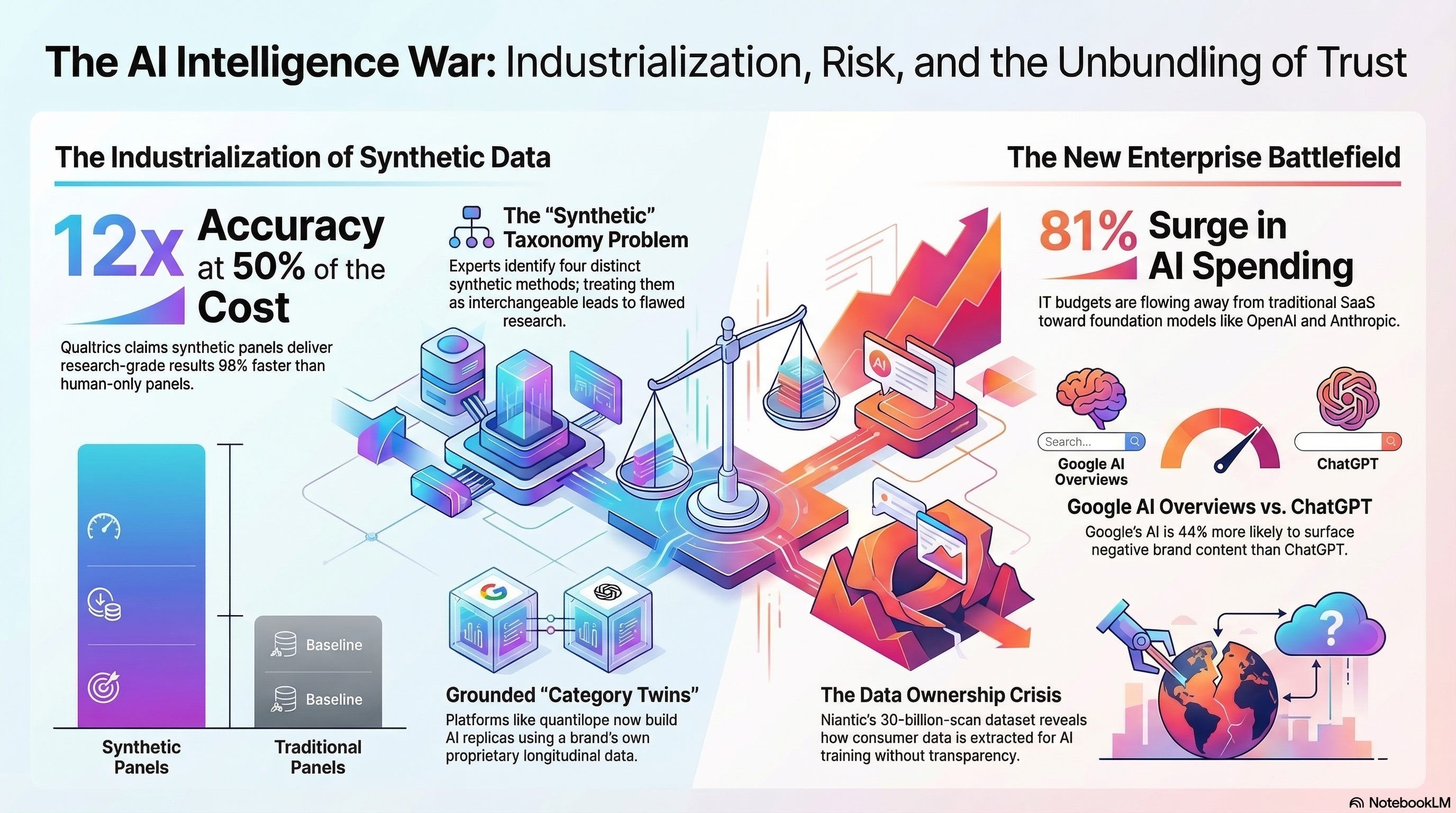
This week the signal intensifies on two parallel tracks: synthetic data is being industrialized by platforms at scale (Qualtrics, quantilope, Fairgen), while fundamental questions about data ownership, AI brand risk, and the future of the knowledge layer itself are escalating simultaneously. The “last mile” and governance themes we’ve been tracking for months crystallize into concrete product launches, infrastructure bets, and a blunt market question: who owns the intelligence layer—OpenAI, the enterprise stack, or the research platforms?
1. Synthetic data industrialization: Qualtrics X4, quantilope Category Twins, and the taxonomy problem
Qualtrics X4 – synthetic panels, Research Hub, and guided methodology
At its X4 conference, Qualtrics announced sweeping updates to its Market Research suite. Key launches:Synthetic panels for US consumers: Built on a fine-tuned LLM trained specifically for market research, Qualtrics claims 12x better accuracy in matching human responses than general-purpose AI, delivering research-grade results in hours at half the cost. UK, Ireland, Canada, Australia/NZ expansions are coming in H1 2026.
Research Hub with AI Summary & Recommendations: Turns existing research across an organization into a conversational answer engine, surfacing findings, eliminating duplication, and recommending methodologies (Conjoint, MaxDiff) when existing data is insufficient.
Case study standout: Gabb used synthetic panels alongside human panels, achieving insights 98% faster, at half the cost, with results that matched human data—calling synthetic data their “cultural radar” for early-stage testing.
Release: Qualtrics turns market understanding into faster decisions.
quantilope’s Category Twins
quantilope launched synthetic “Category Twins”—AI replicas of specific audiences built from a client’s own brand health tracking data for early-stage market research. This is an important distinction: these twins are grounded in proprietary longitudinal data, not generic LLM priors.
Article: quantilope Launches Synthetic “Category Twins” | MRWeb: Synthetic Research Entry for quantilope.Samuel Cohen: “Synthetic data is doing too much work as a term”
Building on his previous work, Samuel Cohen (Fairgen) published a widely shared LinkedIn post arguing that “synthetic data” describes at least four distinct methods in market research scope, and the market treats them as interchangeable—that’s where bad research starts.
Post: “Synthetic data is doing too much work as a term” – Samuel Cohen.
Throughline:
Synthetic data is no longer a fringe experiment—it’s being industrialized by major platforms at half the cost and 12x accuracy claims. But Cohen’s taxonomy warning, which we flagged last week as critical, is now even more urgent: as Qualtrics, quantilope, and others scale synthetic capabilities, buyers need a shared vocabulary to evaluate what they’re actually buying and where human panels remain irreplaceable.
2. AI brand risk gets quantified—and it’s worse than thought
Google’s AI Overviews are 44% more likely to trash your brand than ChatGPT
Fortune reports a study of hundreds of millions of AI prompts finding that Google’s AI Overviews are 44% more likely than ChatGPT to surface negative brand content, and that this content is now sometimes the first thing consumers see—no longer buried on page 10.
Article: Google’s AI overviews are 44% more likely to trash your brand than ChatGPT – Fortune.Contentsquare: journeys now begin inside AI assistants
Contentsquare launched new AI agent and analytics capabilities to track and understand customer journeys across LLMs, ChatGPT apps, web, and mobile—because journeys that once started on websites now begin inside AI assistants.
Release: Contentsquare Launches New AI Agent and Analytics Capabilities.
Throughline:
The “market to chatbots” theme now has a sharp competitive dimension: Google’s AI Overviews are a materially different brand-risk surface than ChatGPT, and the customer journey analytics stack must now map behavior inside AI assistants, not just on owned digital channels.
3. The intelligence layer war: OpenAI Frontier vs. the enterprise stack
OpenAI Frontier vs. SaaS—a fight the industry can’t afford to lose
AI News reports that OpenAI’s Frontier platform bypasses embedded vendor tools to act as a unified intelligence layer across an enterprise’s entire stack, directly threatening the per-seat SaaS licensing model. Salesforce, ServiceNow, and Microsoft are pivoting to consumption pricing in response. CIOs face a binary architectural choice: intelligence siloed within apps, or a neutral orchestration layer that operates above them.
Article: OpenAI Frontier Puts Enterprise AI Agents at the Centre of a Fight the SaaS Industry Cannot Afford to Lose.SaaStr: up to 70% of the software slowdown is budgets flowing to Anthropic and OpenAI
SaaStr reports that Anthropic and OpenAI now capture $40–50 billion in annual enterprise spend, redirecting funds from traditional SaaS vendors. Overall IT budgets are growing only 3.4%, while AI spending is surging 81%—meaning every dollar going to foundation models is coming from somewhere else.
Article: How Much of the Software Slowdown Is Just Budgets Flowing to Anthropic and OpenAI? Maybe As Much As 70% – SaaStr.PitchBook + Perplexity MCP integration
PitchBook announced a new Essential MCP integration with Perplexity, expanding access to AI-powered, verifiable market intelligence through an agent-to-data connection.
Release: PitchBook announces new Essential MCP integration with Perplexity.IQVIA unveils IQVIA AI – a unified agentic AI platform
IQVIA announced IQVIA AI, a unified agentic AI platform for the healthcare and life sciences intelligence market.
Release: IQVIA Unveils IQVIA AI, a Unified Agentic AI Platform.
Throughline:
The budget math is now explicit: SaaS platforms are losing share to foundation model providers, and OpenAI is explicitly trying to become the enterprise intelligence layer above all existing tools. For research and insights platforms, the strategic question is whether to integrate with the intelligence layer or become part of it—before the architectural decisions above them get locked in.
4. Data ownership, the Pokémon Go dataset, and the broken supply chain
“When your bank steals your money”—data as IP and the broken ownership supply chain
Vivek Bhaskaran’s LinkedIn essay on SaaS data misappropriation sparked important commentary: the contractual “chain of ownership” of research data assets desperately needs clarity, and business models need to be rethought from the ground up. The supply chain runs from people → data collectors (sample providers, platforms) → end clients, and the implicit trust that data would only be used to benefit the data owner has broken down across the SaaS industry.
Article: When your bank steals your money – Vivek Bhaskaran.Niantic’s Pokémon Go dataset: 30 billion real-world scans built covertly
A viral thread reveals that Niantic disclosed 143 million Pokémon Go players unknowingly produced one of the largest real-world visual AI datasets in history—over 30 billion photos and AR scans. Players thought they were catching Pokémon; they were building proprietary AI training data.
Thread: Mark Gadala-Maria (@markgadala) on X.Paperclip: open-source orchestration for zero-human companies
“dotta” on X open-sourced Paperclip, billed as “the orchestration layer for zero-human companies”—including org charts, goal alignment, task ownership, budgets, and agent templates.
Thread: dotta (@dotta) on X.
Throughline:
The data ownership crisis, the Pokémon Go revelation, and Paperclip’s “zero-human company” orchestration layer all converge on the same uncomfortable truth: data has always been extracted from people with minimal transparency, and agents are now making that extraction autonomous, invisible, and at scale. This is a governance time bomb for the research industry, which depends on the consent and trust of the very people whose data powers it.
5. MiroFish, simulation, and the “God View” terminal
Claude builds a MiroFish God View terminal—and it’s working
A viral thread describes someone asking Claude to build a “MiroFish God View terminal” that rendered 56 live AI agents with memories, personalities, and behaviors, forming groups, developing leaders, and shifting opinions in real time when fed a scenario. This isn’t a demo from a startup—it’s a user-assembled simulation on top of existing tools.
Thread: Hanako (@hanakoxbt) on X.Peter Diamandis: “Supersonic Tsunami: The Next 6 Months”
Peter Diamandis framed the current AI moment as a “supersonic tsunami” arriving in the next six months—a characterization of the pace and scale of disruption now underway.
Thread: Peter H. Diamandis (@PeterDiamandis) on X.“The marginal cost of entrepreneurship is trending toward zero”
A viral thread argues that AI is driving entrepreneurship cost to near zero, enabling one-person businesses to execute across coding, design, marketing, and sales simultaneously.
Thread: Varshika Prasanna (@varshikaARK) on X.
Throughline:
From swarm intelligence to zero-cost entrepreneurship to the Paperclip “zero-human company,” the infrastructure for autonomous agent-driven businesses is assembling in public, faster than governance can catch up. The MiroFish God View terminal is especially telling: simulation at scale is no longer a specialized platform—it’s a Claude prompt away.
6. Research platform and product launches
Research Results launches RADAR – respondent validation
Research Results launched RADAR, a new respondent validation and data quality tool aimed at strengthening the integrity of survey data.
Release: Research Results Launches RADAR.Phebi expands Emotion Intelligence with conversational AI
Phebi expanded its emotion intelligence offering with conversational AI for surveys and interviews, adding deeper behavioral and emotional signal capture.
Release: Phebi Expands Emotion Intelligence Offering.Quillit (Civicom) updates – 300-file capacity, PowerPoint export
Quillit, powered by Civicom, announced major updates: 300-file processing capacity, exportable PowerPoint generation, and an improved UI for qualitative research efficiency.
Release: Quillit Announces Major Updates.NIQ’s Ask Arthur adds AI-powered analytical capabilities (beta)
NIQ launched a beta of new AI-powered analytical capabilities inside Ask Arthur, its conversational analytics product.
Release: NIQ Launches Beta of New AI-Powered Capabilities in Ask Arthur.Basis Global + AnswerRocket – AI MR partnership
Basis Global and AnswerRocket partnered to use AI to improve how market research is done—specifically promising not to trade speed and practicality against depth and confidence, which they argue most MR AI does.
Article: Basis and AnswerRocket Form AI MR Partnership | Integrated Intelligence: AI-Enhanced Brand Tracking.Displayr adds Report Chat – natural language answers hyperlinked to data
Displayr launched an AI-based chat interface for reports, allowing stakeholders to ask natural language questions with each response hyperlinked to supporting tables and charts.
Article: Displayr Adds Report Chat Feature.Kantar + Quilt.AI – EvaluateExplorer innovation tool
Kantar announced a strategic partnership with Quilt.AI, including a non-equity financial commitment to co-develop joint offers. Their first joint product is EvaluateExplorer, a new innovation tool.
Article: New AI Partner and Innovation Tool Launch for Kantar.VideoMining’s Behavior Scout™ – AI-driven in-store shopper research
VideoMining launched Behavior Scout™, a rapid in-store testing and shopper research program using AI-driven behavioral analytics to diagnose shopper friction, quantify growth opportunities, and validate in-store innovations.
Release: VideoMining Launches Behavior Scout™.Logica Research: AI and the Future of Work
Logica Research published findings from its Future of Money Study, examining how AI is reshaping jobs, skills, and expectations—including the importance of employer-supported upskilling.
Article: AI And The Future Of Work – Logica Research.
Throughline:
Across a dozen platform launches this week, the pattern is consistent: every layer of the research stack—qual, quant, analytics, reporting, in-store, emotion—is getting an AI layer bolted on or rebuilt from scratch. The risk is fragmentation; the opportunity is for whoever builds the governance and orchestration layer above them all.
7. Industry moves: sample, media, and the creative brief
ACKWEST acquires Answerpoints UK panel from Aurora
ACKWEST acquired the Answerpoints™ consumer panel from Aurora Market Research, expanding its access to deeply profiled UK consumers and strengthening its first-party data ecosystem.
Post: ACKWEST Acquires Aurora’s Answerpoints UK Panel.Guideline’s Local Dynamics – transaction-data-powered local ad spend tracking
Guideline launched Local Dynamics, a subscription report tracking advertising investment across US local markets using transaction data.
Article: Guideline Uses Transaction Data to Track Local Ad Spend.Nielsen discontinues TV and radio ad monitoring in major markets
Nielsen is discontinuing TV ad occurrence monitoring in 137 markets and shuttering its SIGMA radio ad monitoring service.
Article: Nielsen Drops TV and Radio Ad Tracking in Some Markets.Meta shuts down Horizon Worlds VR metaverse
Meta announced a shutdown date for Horizon Worlds, its VR metaverse—a significant concession that the original metaverse bet failed, and that agent networks (Moltbook) are Meta’s actual bet on the next social layer.
Article: Meta is pulling the plug on its VR metaverse – TechRadar.“The Creative Brief Is the Last Human Artifact”
Magnolia Made argues that AI is commoditizing both research and execution, leaving the creative brief as an agency’s last and most defensible asset—the place where human judgment, strategic framing, and brand intuition still generate irreplaceable value.
Article: The Creative Brief Is the Last Human Artifact – Magnolia Made.DoorDash’s Dasher Tasks – physical intelligence frontier
DoorDash introduced Dasher Tasks, allowing Dashers to get paid for general tasks beyond delivery, framing it as “building the frontier of physical intelligence”—an interesting signal that agentic physical-world data collection is coming.
Thread: Andy Fang (@andyfang) on X.Google Stitch – vibe design platform
Google Labs introduced Stitch, a “vibe design” platform that transforms natural language into high-fidelity designs on an AI-native canvas. Paired with Pomelli from last week, Google is clearly moving to democratize AI-powered creation across design, campaign, and content.
Thread: Google Labs (@GoogleLabs) on X.
Throughline:
Nielsen’s retreat from traditional ad tracking, Meta’s metaverse exit, and DoorDash’s physical intelligence play all signal major realignments of where data gets collected, measured, and monetized. The creative brief essay is a critical counterweight to the automation wave: even as AI commoditizes execution, the strategic framing work that defines what to make and why remains stubbornly human.
Big idea of the week
The great unbundling of trust: data ownership, synthetic accuracy, and the AI brand-risk surface are all breaking open at the same time.
Three fault lines are cracking simultaneously:
The data supply chain is broken—and the industry knows it.
Vivek Bhaskaran’s essay, the Pokémon Go revelation, and the synthetic-data taxonomy debate all point to the same structural failure: the chain of consent, ownership, and value attribution from respondent to end-client has never been formalized—and AI is making the stakes existential. This is the ground floor of Startup Concept #1 (Insight QA and provenance) from last week’s discussion.Synthetic data is becoming a commodity before governance arrives.
Qualtrics’ 12x accuracy claim, quantilope’s brand-specific twins, and Cohen’s four-method taxonomy are all happening simultaneously. Buyers are making purchase decisions based on incompatible definitions of “synthetic data” while platform claims outpace independent validation.AI brand risk is now asymmetric and measurable—44% more negative in Google, near-purchase criticism in ChatGPT.
The AI visibility theme we’ve tracked since the first week of this series now has a specific, quantified threat: different AI surfaces expose brands to different risks, and the surface your competitor isn’t managing is the one that will hurt you first.
For insight and marketing leaders, this week’s question is: Do you have a clear map of what each major AI surface says about your brand, a synthetic-data policy that reflects the actual method diversity behind the term, and a data ownership framework that can withstand the scrutiny now coming for the whole research supply chain? If not, all three gaps are now competitive vulnerabilities—not just operational ones.