
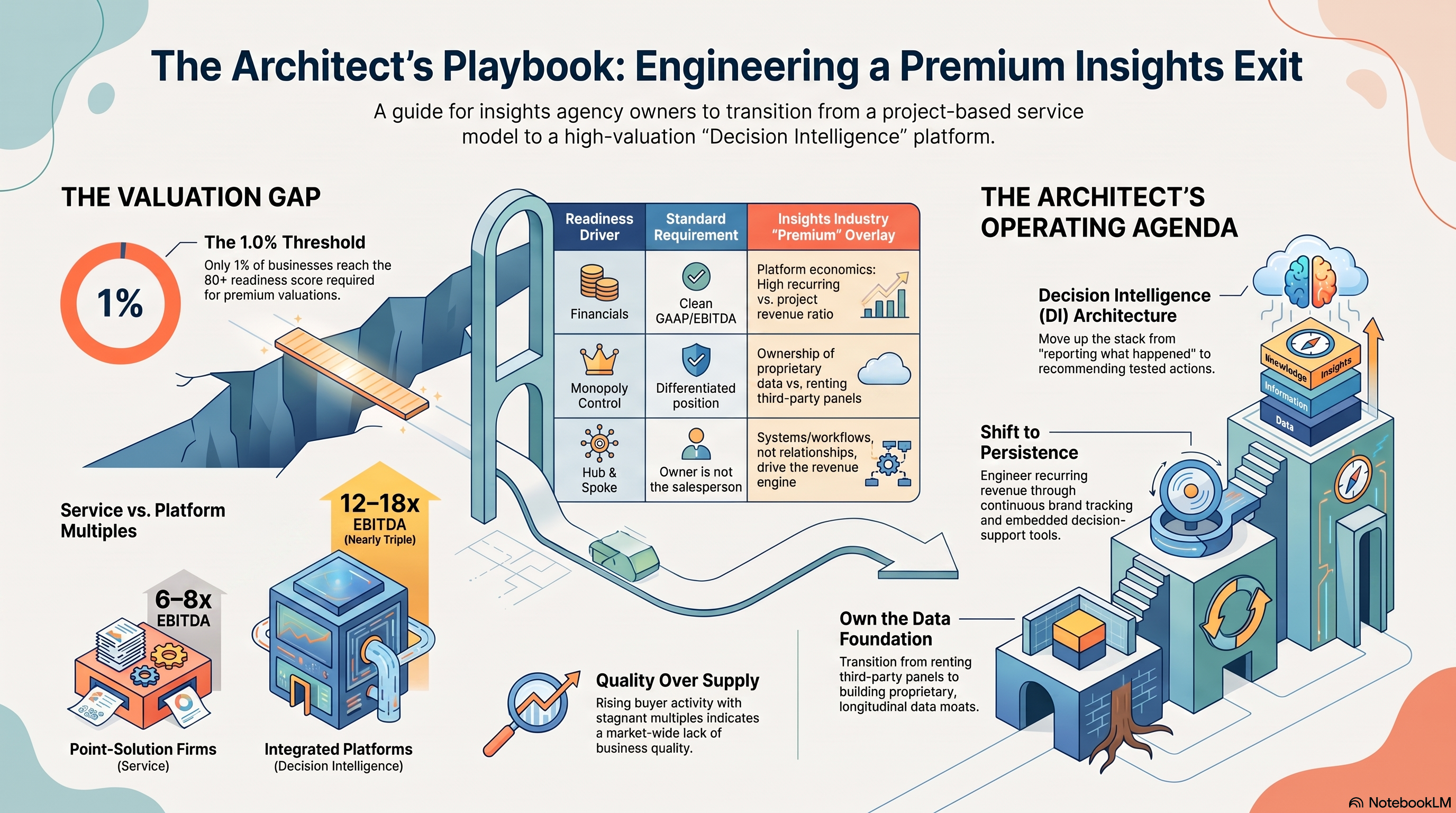
This is the third post in a series. The first argued that the “next roll-up” will not be a collection of research agencies — it will be the assembly of insight infrastructure. The second explored what the private equity market is telling the insights industry about where strategic value is moving. This post asks the operating question those two set up: if you lead a small to mid-sized supplier, what is the actual work that needs to get done before a transaction can create premium value rather than extract it?
The Gap Is Wider Than Most Owners Think
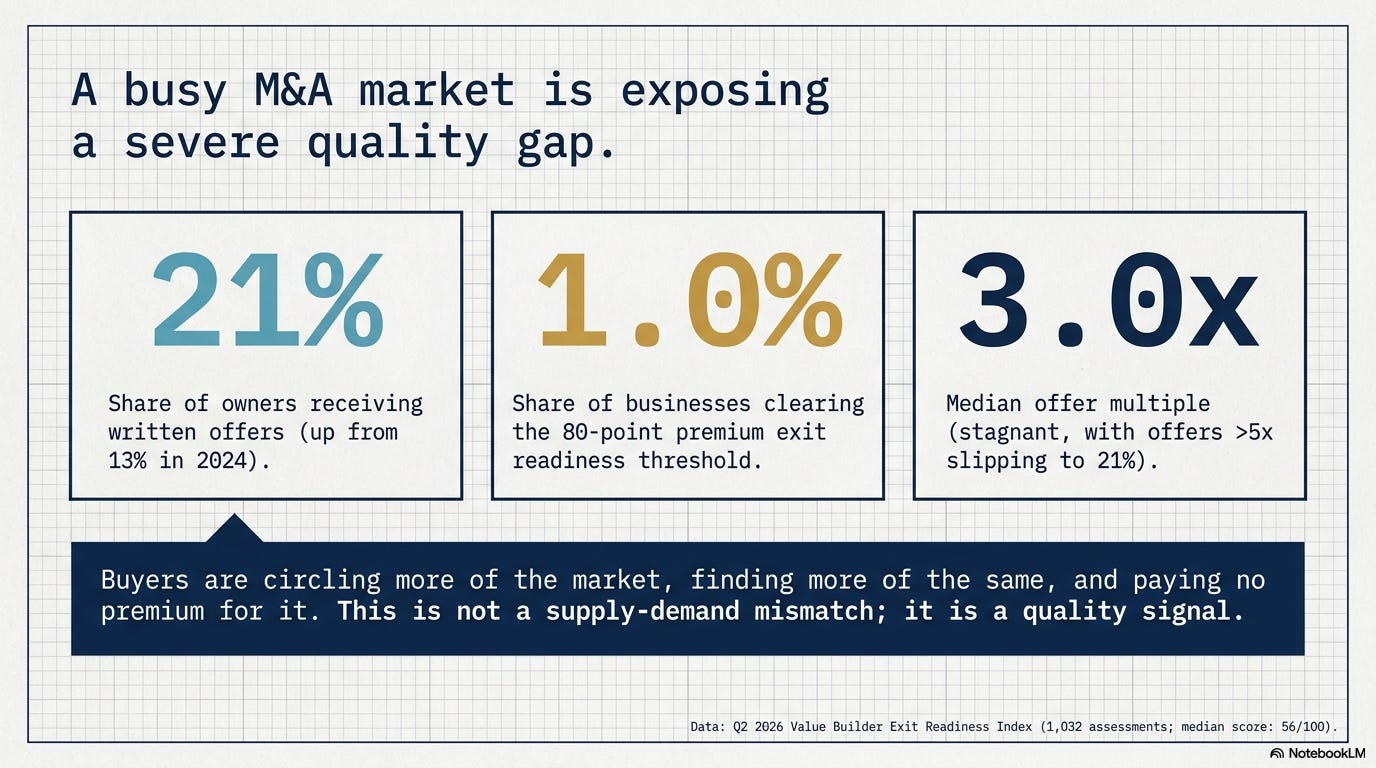
Start with the hard data. The Value Builder Exit Readiness Index for Q2 2026, drawn from 1,032 completed owner assessments, puts the median business exit readiness score at 56 out of 100. The share of businesses clearing the 80-point threshold associated with premium exit valuations sits at just 1.0% — a figure that has not exceeded 1.7% in any quarter since 2024. In the broader middle market, 21% of owners received a written offer in the past year, up from 13% in late 2024, but the median offer multiple has held steady at 3.0x earnings, and the share of offers at 5x or better has actually slipped from 25% to 21%.
Read those numbers together. Buyer activity is rising. Prices are not following. That is not a supply-demand mismatch. That is a quality signal. Buyers are circling more of the market, finding more of the same, and paying no premium for it.
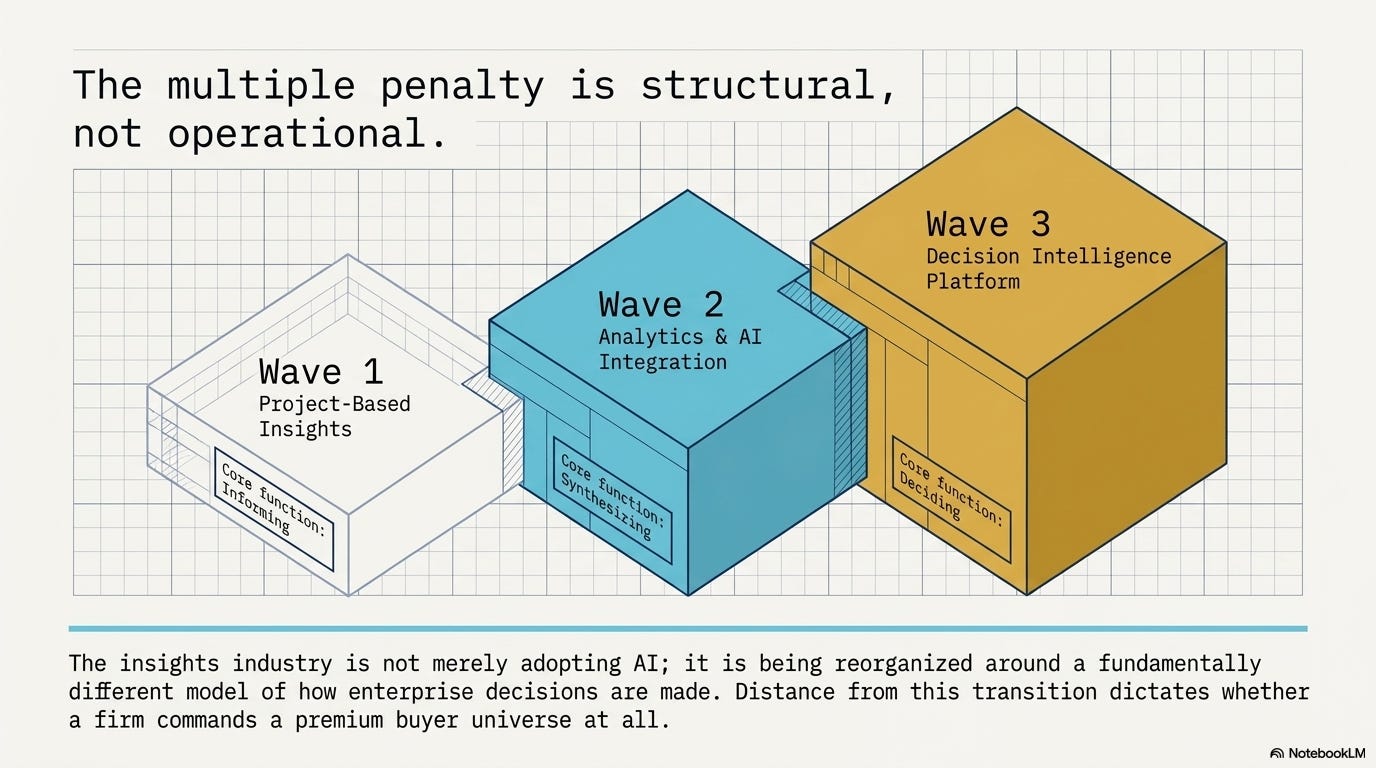
For insights suppliers specifically, the gap is not just about operational hygiene. It has a structural dimension that the broader business exit literature does not fully capture. The industry is in the middle of its most consequential architectural transition in a generation — from project-based insights delivery toward what is increasingly being called Decision Intelligence platform status. As we argued in The Industry Is Being Redrawn. Here’s the Map., the insights and analytics industry is not merely adopting AI — it is being reorganized around a fundamentally different model of how enterprise decisions get made, and who makes them. How close or far a supplier sits from that transition changes not just what it is worth today, but whether it will command a premium buyer universe at all.
What the PE Market Has Already Said
The prior two posts in this series tracked the signals carefully, so there is no need to repeat the full argument here. The short version is this.
The smartest PE firms are no longer looking for research vendors. They are looking for what the first post described as “infrastructure disguised as services, data assets trapped in legacy wrappers, and undervalued companies.” The screening criteria have changed. The buyer thesis has changed. And that changes what “exit-ready” means for a supplier.
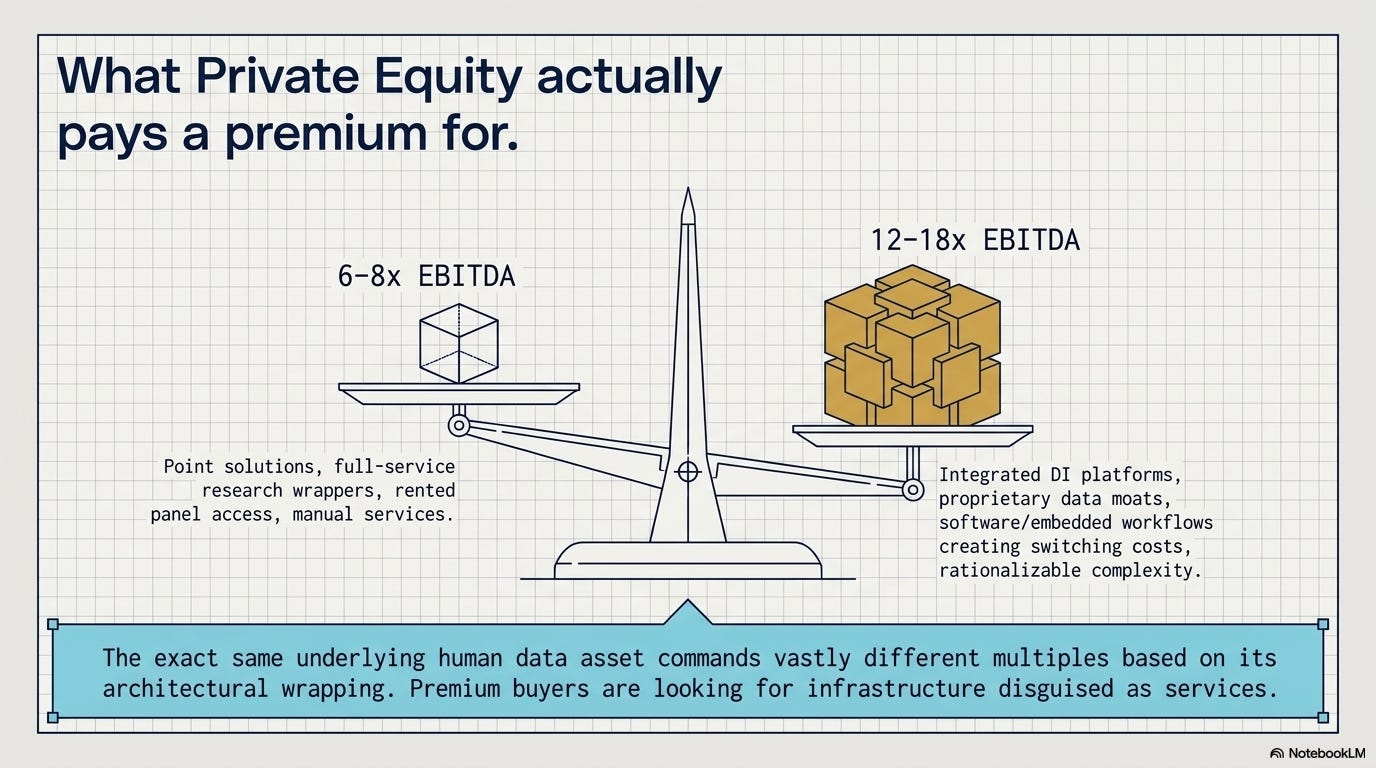
What PE actually pays a premium for in this category maps to a fairly consistent set of asset characteristics:
A defensible control point in the insight-to-activation chain
Proprietary or operationally differentiated data foundations — not rented panel access
Software or workflow embedded enough to create switching costs
Services that improve implementation and retention rather than simply adding labor
Complexity that can be rationalized into a cleaner platform
Room for category redefinition and multiple expansion
The same underlying human data asset commands 6–8x EBITDA as a point solution and 12–18x as an integrated platform. That is not a small spread. It is the difference between a company that gets absorbed in a consolidation at a thin multiple and one that becomes the anchor of a PE-backed platform thesis.
The business category reframing matters just as much as the operational improvements. Companies in this space that still describe themselves as “full-service research firms” will be underwritten on research-firm comps. Companies that have translated themselves into decision infrastructure language — and, more importantly, built the product and revenue architecture to back up that language — will be underwritten on platform comps.
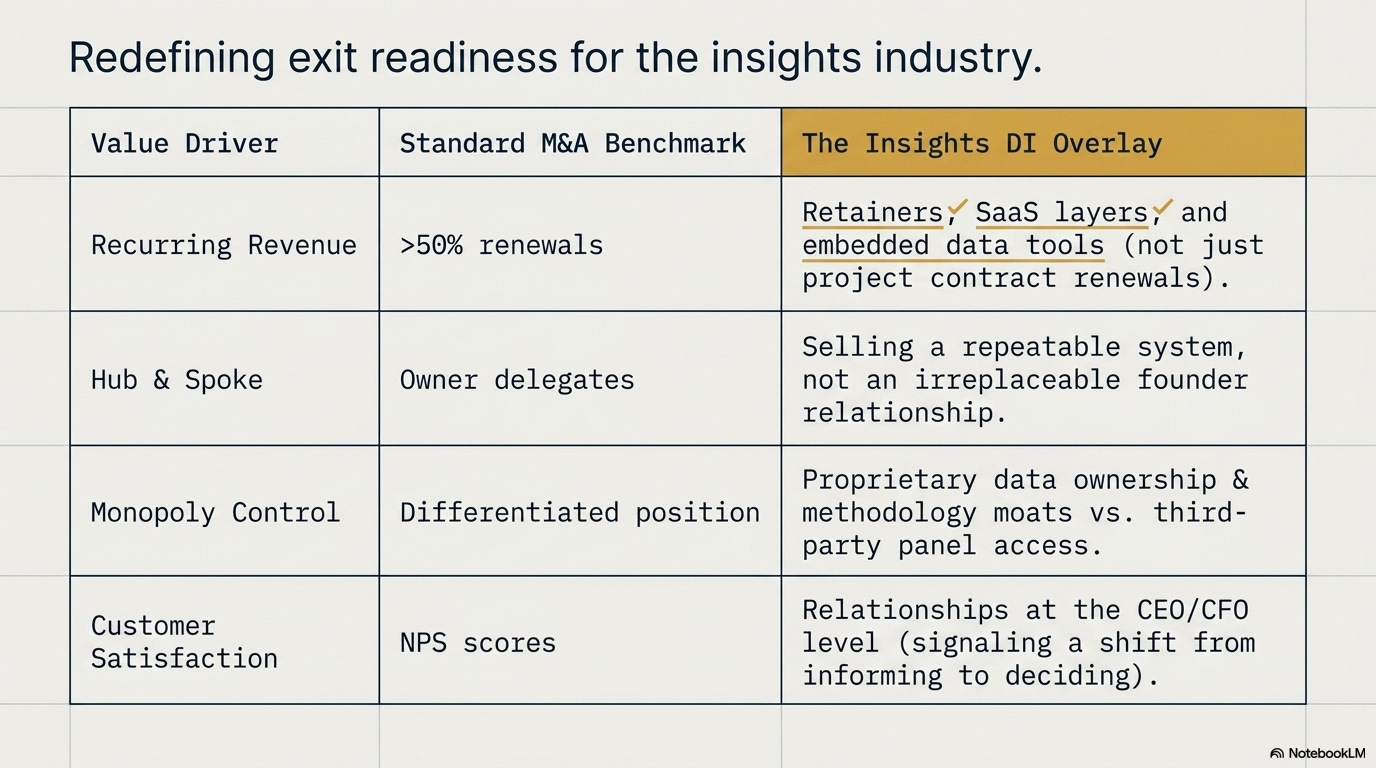
That translation is not cosmetic. It requires doing actual work.
The Decision Intelligence Lens Changes the Readiness Checklist
The standard Value Builder exit readiness framework tracks eight value drivers: financial performance, growth potential, Switzerland structure (revenue concentration), valuation teeter-totter (the mix of recurring versus project revenue), monopoly control (proprietary positioning), customer satisfaction, hub-and-spoke (owner dependence), and management team depth.
All eight still matter. But for insights suppliers, they need to be read through a second overlay: where does the company sit on the three-wave spectrum from project-based insights (Wave 1) to analytics and AI integration (Wave 2) to Decision Intelligence platform (Wave 3)? This framework has been developed at length in our prior work; readers new to it should start with The Industry Is Being Redrawn. Here’s the Map. That overlay changes the interpretation of almost every standard driver.
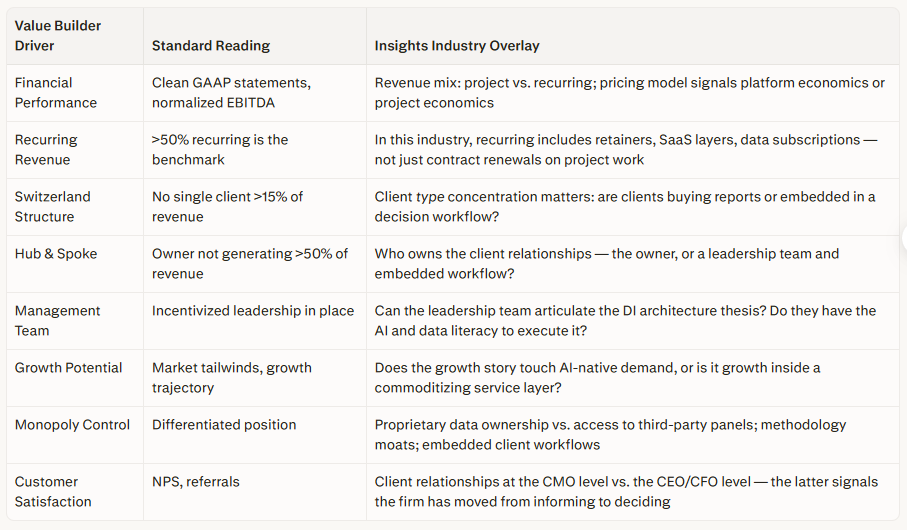
The Q2 2026 data shows that the most-improved driver category across the broad business population is hub-and-spoke — specifically, the share of owners who personally generate more than 50% of revenue dropped from 53.7% to 46.5% year over year. That is directionally correct. But in the insights industry, owner-dependence in revenue generation is often a symptom of a deeper structural problem: the firm is selling relationships, not a repeatable system. Solving it requires more than delegation. It requires building the system that makes delegation real.
The Work That Actually Gets Done
Here is the operating agenda, sequenced by priority and time horizon.
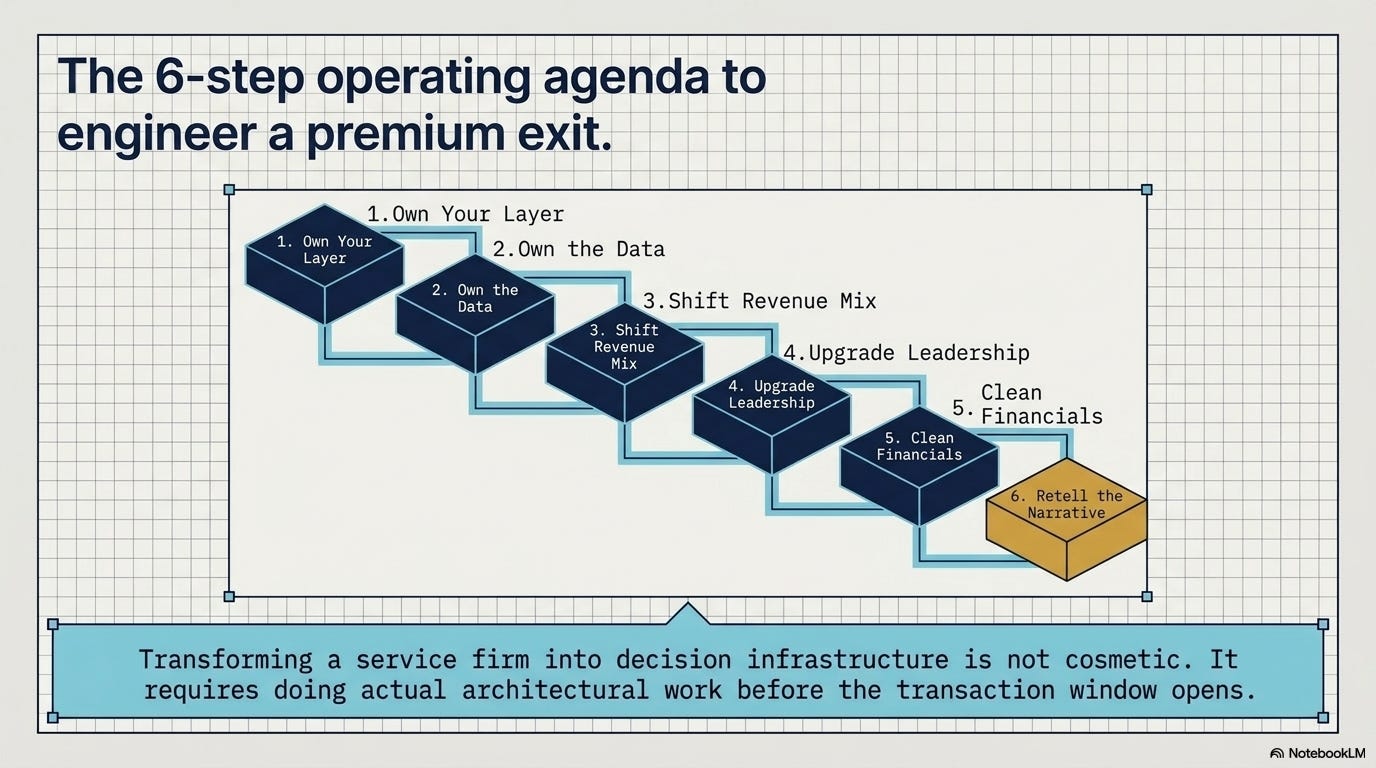
1. Decide What Layer You Own
This is the first decision and it governs everything else. Before any operational improvement has strategic value, the leadership team needs a clear answer to a blunt question: Where in the insight-to-decision stack does this company actually occupy a control point?
The six-layer Decision Intelligence architecture — developed in full in The Data Infrastructure Layer Is Being Rebuilt and in the companion DI investment thesis — provides the map:
Layer 1 — Verified human behavioral data (the irreplaceable foundation)
Layers 2–3 — Predictive AI modeling and continuous analytics
Layers 4a–4c — Synthetic personas, digital twins, market simulation
Layer 5 — Integrated consumer understanding (the Living Intelligence System)
Layer 6 — The decision layer: recommended actions, tested before commitment
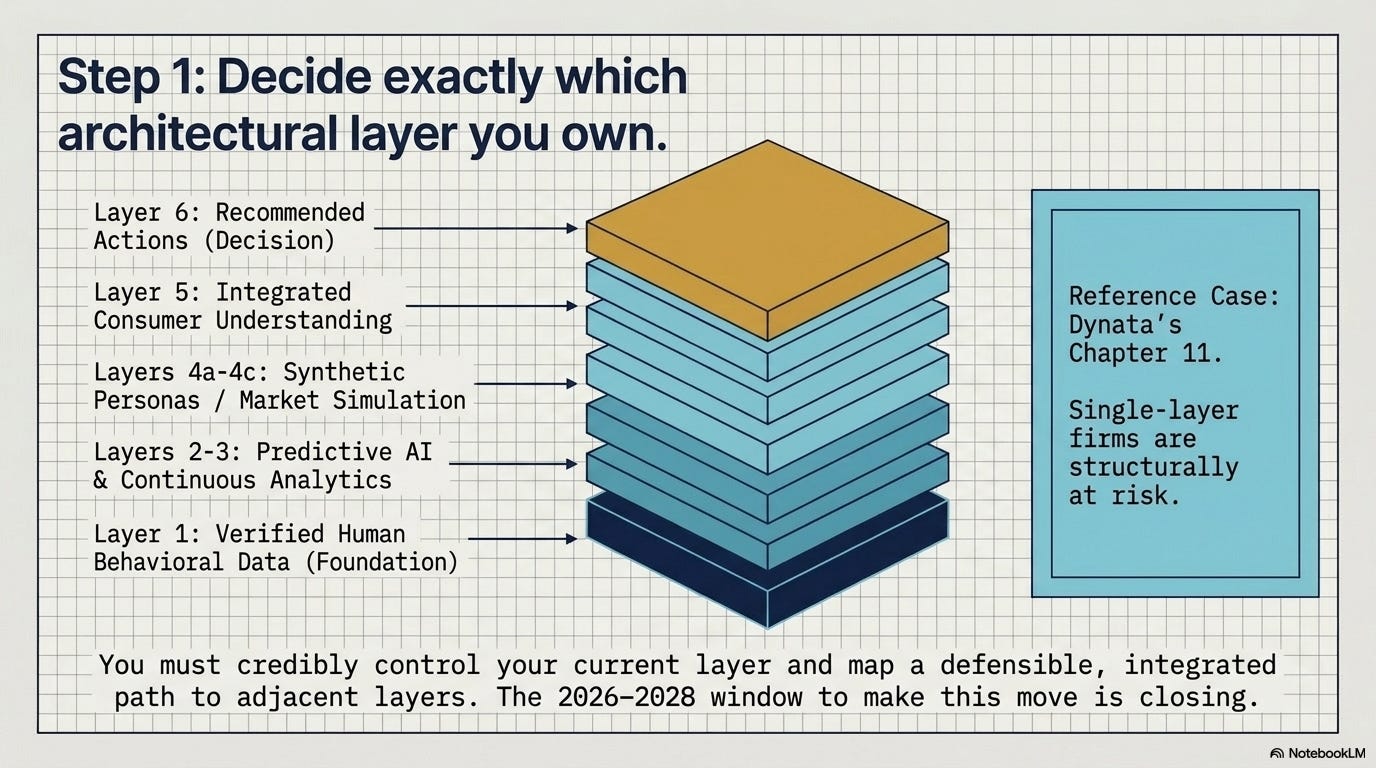
Single-layer firms — pure panel access, a survey platform, a data feed — are structurally at risk. Dynata’s Chapter 11 is the reference case. Any firm that cannot describe a clear path from its current position to multi-layer integration faces a valuation ceiling and a shrinking buyer universe. Wave 1 operators need to understand this clearly. The 2026–2028 window to make the architectural commitment with competitive advantage still intact is closing.
The decision is not whether to reach Layer 6 by tomorrow. It is which layer you credibly occupy and control today, which adjacent layer is the most defensible next step, and what data assets, relationships, or capabilities you already own that anchor the move. Many strong mid-market suppliers are closer to a credible platform story than they realize — they simply have not told it yet, internally or externally.
2. Own the Data, Don’t Just Access It
The most consequential structural gap in the mid-market supplier landscape is the distinction between proprietary data ownership and purchased panel access. It is not a nuance. It accounts for a 4–6x difference in achievable exit multiple.
As the Data Infrastructure Layer post argued, the demand for verified, permissioned, refreshable human data has moved from a nice-to-have to the foundational input of the AI economy. Large language models need it to train. AI agents need it to operate. Enterprise decision systems need it to calibrate. And in the Selling the Mine or Selling the Shovels? post we laid out how firms can structure data partnerships that capture that value without trading away their future.
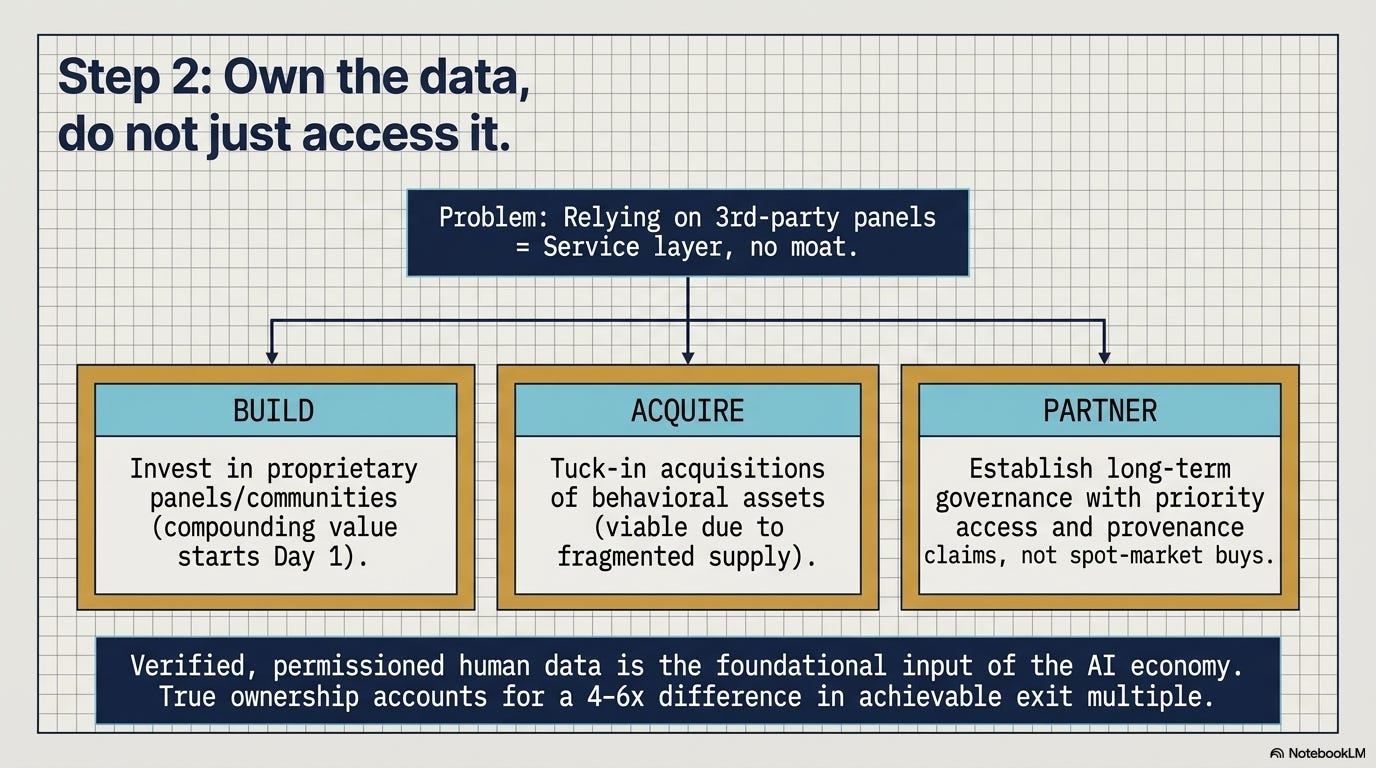
Firms that own their data — longitudinal panels, proprietary respondent databases, behavioral data assets collected under direct consent — hold a structural moat that cannot be assembled from components or synthesized from AI after the fact. Firms that access third-party panels have a service layer, not a data moat.
For suppliers who currently sit on the wrong side of this line, the options are:
Build it: invest in a proprietary panel or community platform, even at modest initial scale; the compounding value of longitudinal data starts from Day 1
Acquire it: tuck-in acquisition of a smaller panel or behavioral data asset — increasingly viable at accessible price points given the fragmentation of the supply landscape
Partner structurally: create a long-term data partnership with terms that give the firm priority access, data governance rights, and provenance claims rather than spot-market sample buys
The same logic applies to proprietary methodologies, benchmarks, and intellectual property. The 2026 GRIT data confirms that mid-size research firms (101 to 500 employees) now lead the industry in revenue growth, capability expansion, and AI governance maturity precisely because they have been more willing to invest in proprietary capability rather than third-party resale.
3. Shift the Revenue Mix Toward Persistence
The Value Builder data shows the share of businesses with majority-recurring revenue (>50%) actually declined year over year, from 49.9% to 46.0%. In a market where PE buyers use recurring revenue as a primary proxy for platform economics versus project economics, this is a serious readiness problem.
For insights suppliers, this requires more than renaming retainers as subscriptions. It requires fundamentally changing what the client relationship is for. As the Future of Professional Services Is a Warning Shot for Market Research post put it: what parts of your delivery model should become software-like? Some revenue will always remain project-based. But the firms building toward premium exits are deliberately engineering persistent value delivery — continuous brand tracking, always-on consumer intelligence, embedded decision support tooling, outcome-linked measurement programs — that creates annual recurring revenue before any formal product exists.
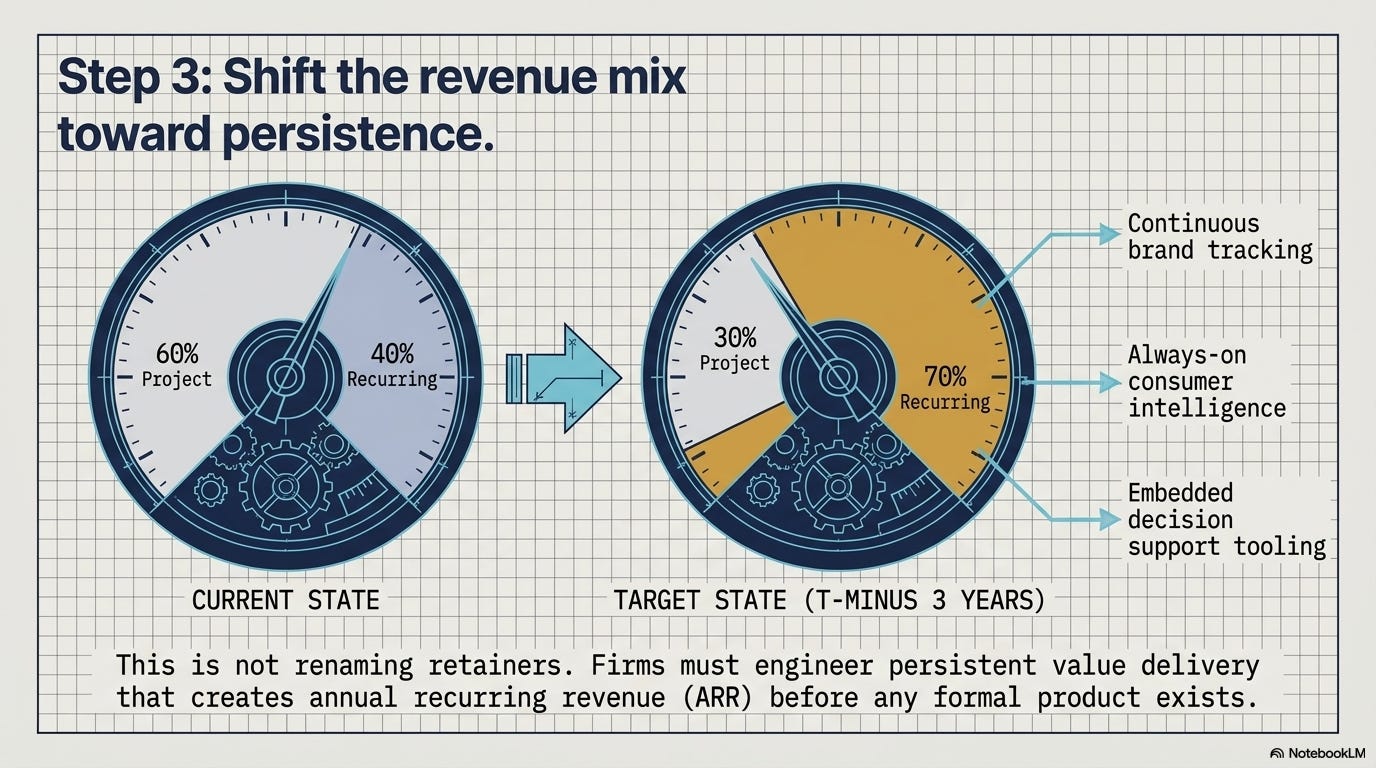
The pricing model shift is part of the value story that PE buyers underwrite. A firm at 60% project / 40% recurring that has a credible roadmap to 30/70 over three years is a fundamentally different asset than headline revenue suggests. The roadmap has to be real and backed by actual client relationships in transition, but the direction of travel is as important as the current ratio.
4. Build the Management Team That Can Survive a Transition
The most improved single indicator in the Q2 2026 Value Builder data is the share of businesses with no management team at all, which fell from 30.1% to 24.4%. Progress. But the flip side — the share of businesses with an incentivized management team in place — remains just 13.3%, barely changed from two years ago.
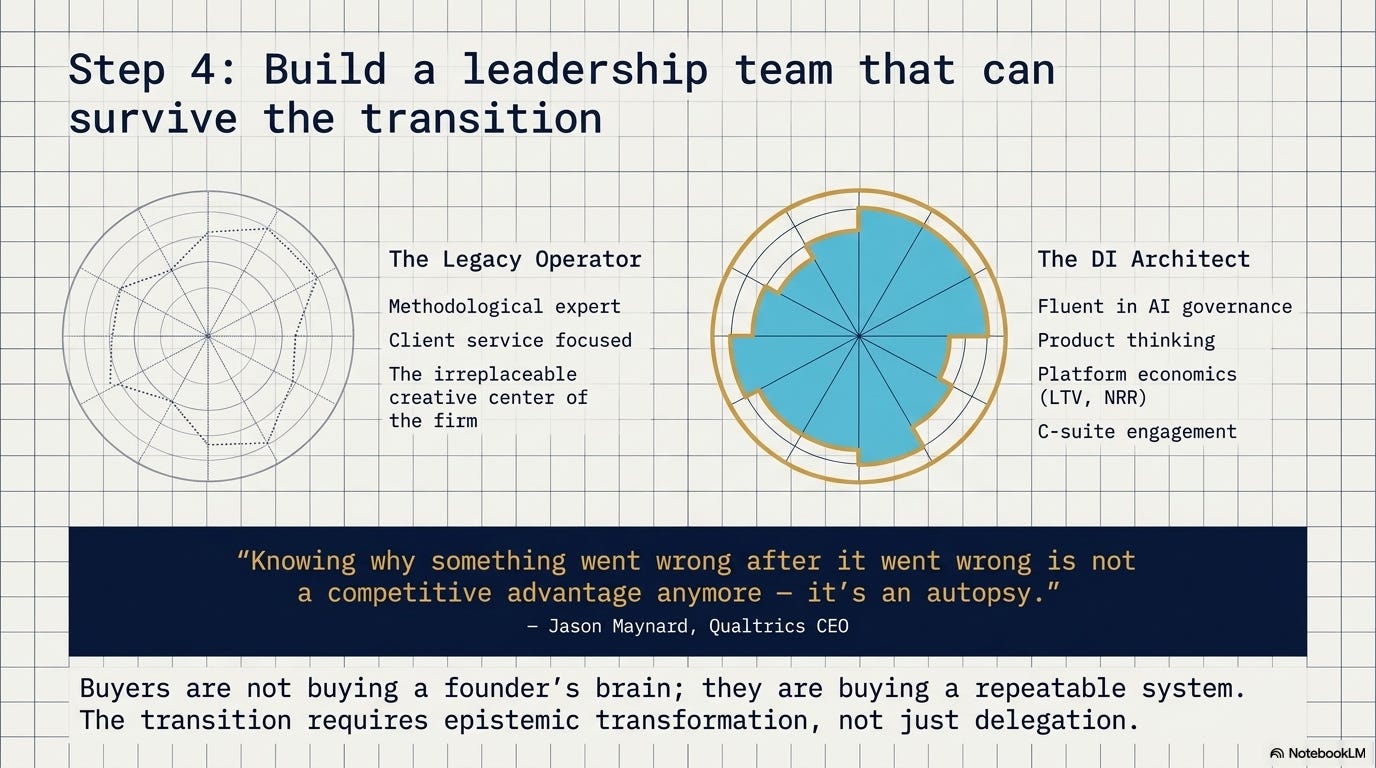
In the insights industry, this is doubly problematic. A transaction buyer is not just buying a book of business. They are buying the capability to execute the architectural transition to Decision Intelligence. That requires a leadership team with specific capabilities that most traditional MR firm management layers do not currently have:
AI and data literacy — not just AI tools awareness, but genuine understanding of the four data types hierarchy (real-human, Type 1 synthetic, Type 2 synthetic, behavioral) and the governance implications of each
Product thinking — the ability to translate service delivery into productized, scalable workflows
Platform economics fluency — the ability to track and communicate recurring revenue metrics, net revenue retention, customer lifetime value, and the KPIs a PE board will require from Day 0
C-suite client relationship capability — the ability to operate at CEO/CFO level, not just CMO/Insights Director level, because that is where the Decision Intelligence buyer relationship lives
The Qualtrics Canary post made this concrete: Qualtrics CEO Jason Maynard declared at X4 that “knowing why something went wrong after it went wrong is not a competitive advantage anymore — it’s an autopsy.” Service firms still leading with insight-as-deliverable need to hear that signal clearly. It is coming from the category leader, and it reflects what the firms that survive the transition already understand: the new product is the decision system, not the report it feeds.
The Qualtrics 2026 Market Research Trends data surfaces a related structural problem: research leaders believe AI has revolutionized their processes at 39%, while only 19% of individual contributors share that view. That perception gap is a management problem as much as a technology problem. Firms that have genuinely resolved it — where the leadership team and the delivery team have shared conviction about the transformation direction — are significantly more credible acquisition targets than firms where the leader has a vision that the organization has not absorbed.
For many founders and owners of small to mid-sized suppliers, this is the personally difficult part. Reducing owner dependence means genuinely building successors — not nominally delegating, but actually ceding revenue relationships, client trust, and decision authority to a team that can run the business without the founder’s daily presence. The Value Builder data that shows just 18.7% of businesses could “hardly suffer” without the owner for three months tells you how far most firms still have to go on this dimension.
5. Clean Up the Financial Architecture
The share of businesses with audited or reviewed financial statements sits at only 25.9%. In the middle market, PE buyers are not just looking for clean GAAP statements — they are increasingly demanding what PitchBook’s Q1 2026 Middle Market Report describes as “QoE 2.0”: transaction-level analytics that reconstruct historical financial performance from the basement, surfacing customer concentration risk, margin compression by cohort, churn masked by aggregate growth, and working-capital drag tied to specific contract terms.
For insights suppliers, this means:
Revenue disaggregation — by client, by project type, by recurring vs. episodic, by methodology layer; the ability to show that growth is broad-based and not dependent on one or two anchor relationships
Margin analysis by service type — what margins does the firm achieve on bespoke project work versus platform-delivered outputs versus data products? The spread matters because it tells the buyer where the economics go as the model transitions
Customer cohort analysis — what is the retention rate by client segment? What is the expansion revenue from existing clients? What is the actual churn, not the reported churn?
Normalized EBITDA with defensible add-backs — founder compensation adjustments, non-recurring expenses, and investment spend that will not recur post-transaction, documented and supported, not estimated
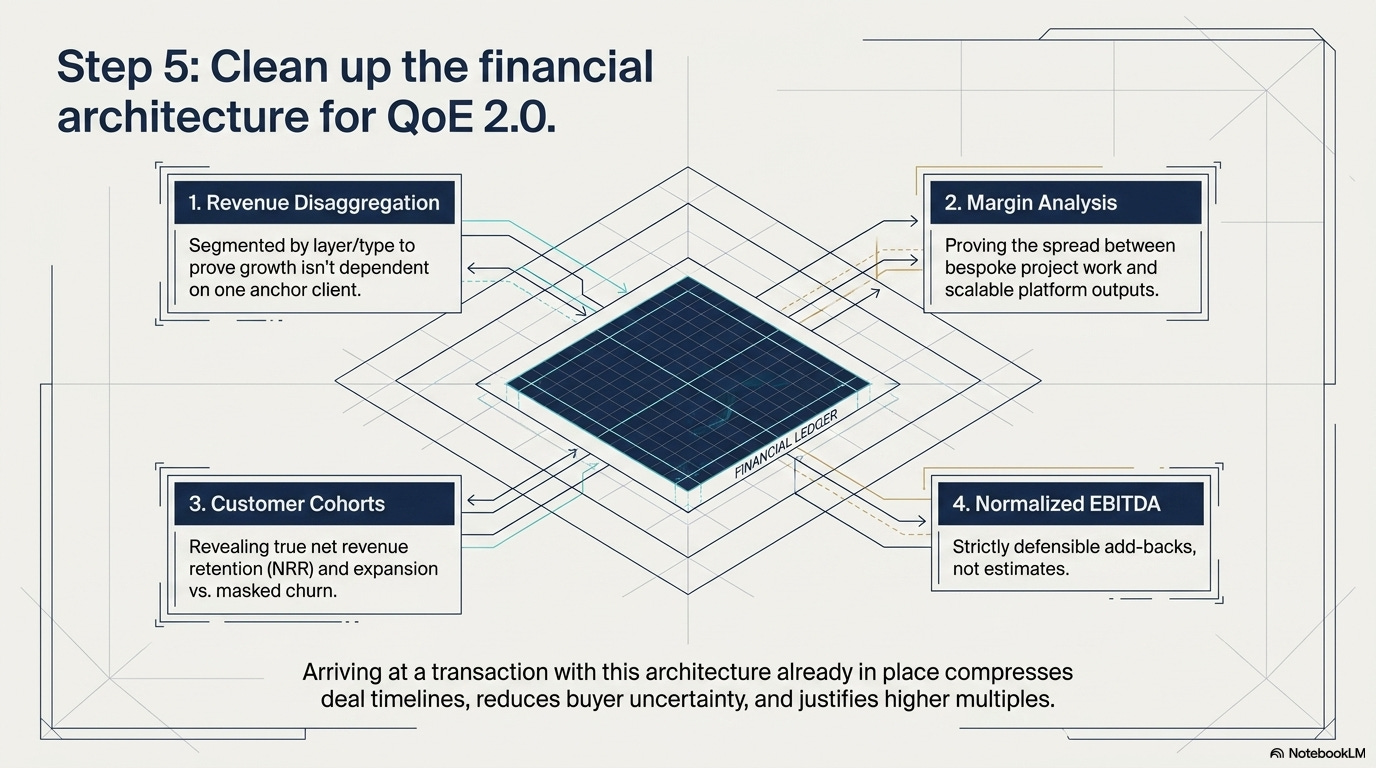
None of this is exotic financial engineering. It is the financial discipline that makes a business legible to a buyer before they spend three months in due diligence figuring it out themselves. Firms that arrive at a transaction with this architecture already in place compress deal timelines, reduce buyer uncertainty, and justify higher multiples. Firms that do not create a Day 0 gap that buyers price into the offer.
6. Build the Narrative, Then the Business
The second post in this series concluded with a precise instruction for operators: companies in this industry need to start telling the truth about what they are becoming. The corollary is that the truth has to be told inside the organization before it can be told to a buyer.
Many small to mid-sized suppliers have real and valuable assets — methodological rigor, earned client trust, proprietary data, genuine AI integration, or sector depth — that are either understated in their market positioning or actively obscured by an outdated “full service” or “boutique agency” label. Category definitions determine multiple ranges. The most dangerous position is being genuinely valuable but invisible to the buyer universe that would pay for that value.
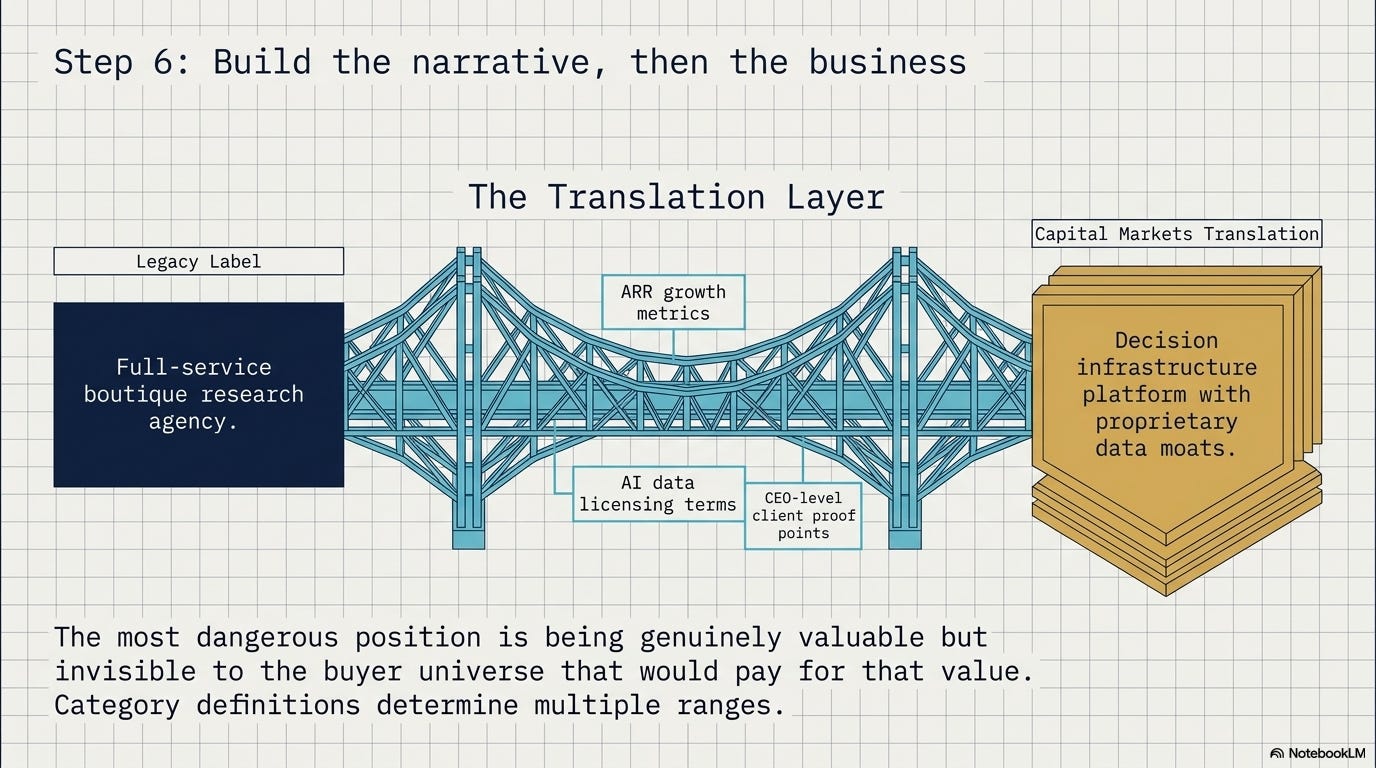
The work is to build what the broader IIV framework calls the translation layer — moving from legacy category definition into the value frameworks that current capital markets actually reward. That means:
Mapping the business to the six-layer DI architecture and being honest about which layers are occupied, which are adjacent, and which are aspirational
Retelling the growth story around platform economics rather than project volume: ARR growth, net revenue retention, platform revenue as a share of total revenue
Identifying which client relationships have already moved to the CEO/CFO level and building more of them — those are the proof points that the business has crossed from informing to deciding
Clarifying data rights and governance so the proprietary data claim survives due diligence, including AI data licensing terms that protect provenance and revocability
As the Future of Professional Services analysis makes clear, the value does not move from producing research to no longer producing research — it moves to operating the decision system around research. Suppliers that understand that framing can describe their current delivery model and their forward ambition using the same language. That coherence is itself a premium signal to a buyer.
The Synthetic Sample Is Not the Market. Decision-Grade Data Is. post adds the governance dimension: as the market moves from “generate respondents” to “assemble decision-grade evidence,” the firms that can document the quality of their data stack — and differentiate real-human data from synthetic augmentation — will command a trust premium that becomes part of the acquisition thesis.
What the Sector Data Tells You About Your Peer Group
For an insights supplier assessing its own position, the Value Builder sector league table is a useful benchmark. The “Information” sector — which captures the closest proxy for MR and analytics firms — leads all sectors with a median readiness score of 63. Professional Services sits at 57, receiving written offers only 9% of the time.
That 63 is not a ceiling. It is an average of businesses ranging from barely-functional owner-dependent shops to genuinely sophisticated platforms. The premium-ready threshold is 80. The work described in this post is the distance between the average of your peer group and the threshold that generates a competitive, premium-multiple exit process.
The 2026 GRIT data adds another layer: mid-size research firms (101 to 500 employees) now lead the industry in revenue growth, capability expansion, and AI governance maturity. That is the cohort that is closing the gap fastest. The firms that are not in that cohort by behavior — regardless of headcount — need to decide whether they want to get there organically or whether a strategic partnership or minority investment makes more sense as an accelerant.
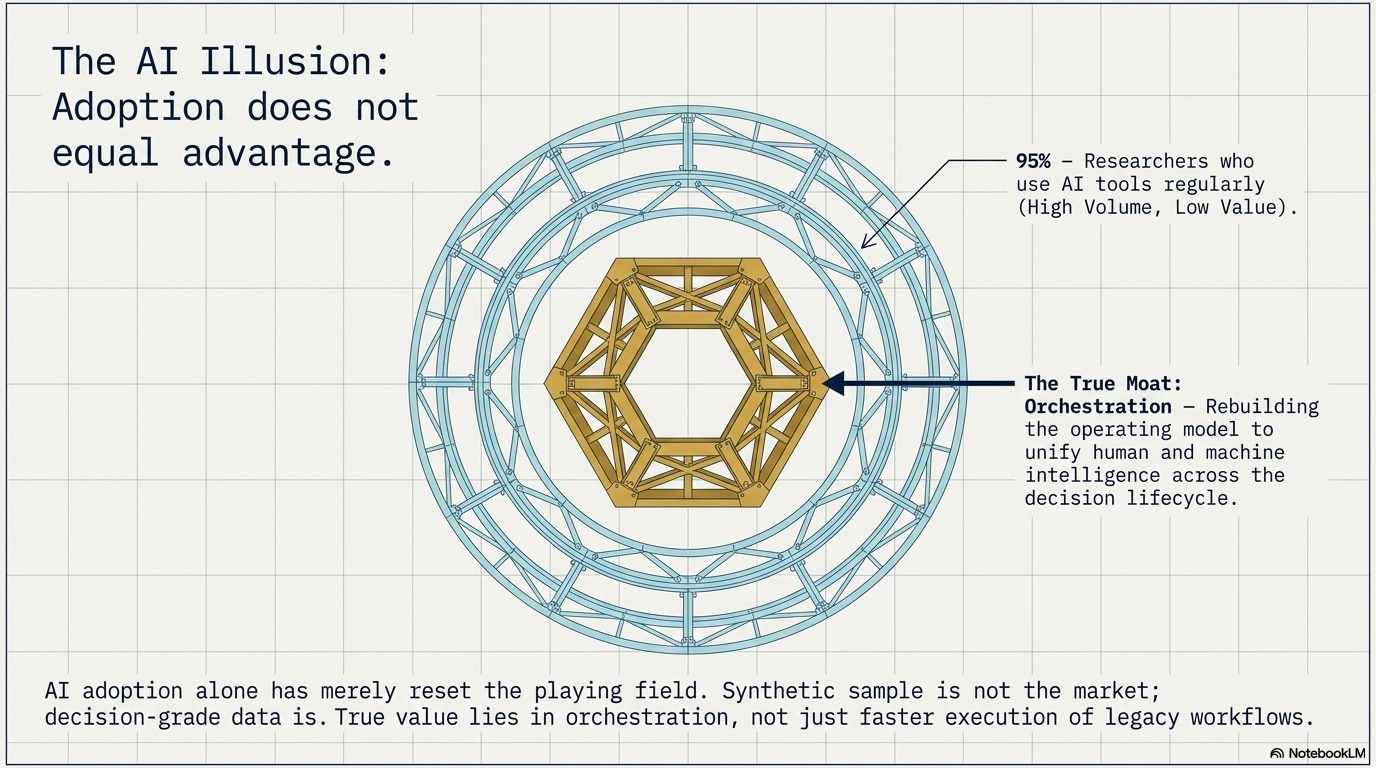
Eighty-eight percent of information-sector businesses are now using AI somewhere in their operations. AI adoption, alone, no longer differentiates. What differentiates is how AI is being deployed — whether it is being used to execute existing workflows faster, or whether it is being used to rebuild the firm around a new operating model. The Qualtrics data is blunt on this point: 95% of researchers already use AI tools regularly, but adoption alone has reset the playing field rather than created advantage. What separates leaders from the rest is orchestration — how effectively firms unify human and machine intelligence across the entire research-to-decision lifecycle.
The Leadership Problem at the Center of All of It
Here is the part of the exit readiness conversation that the quantitative frameworks underweight.
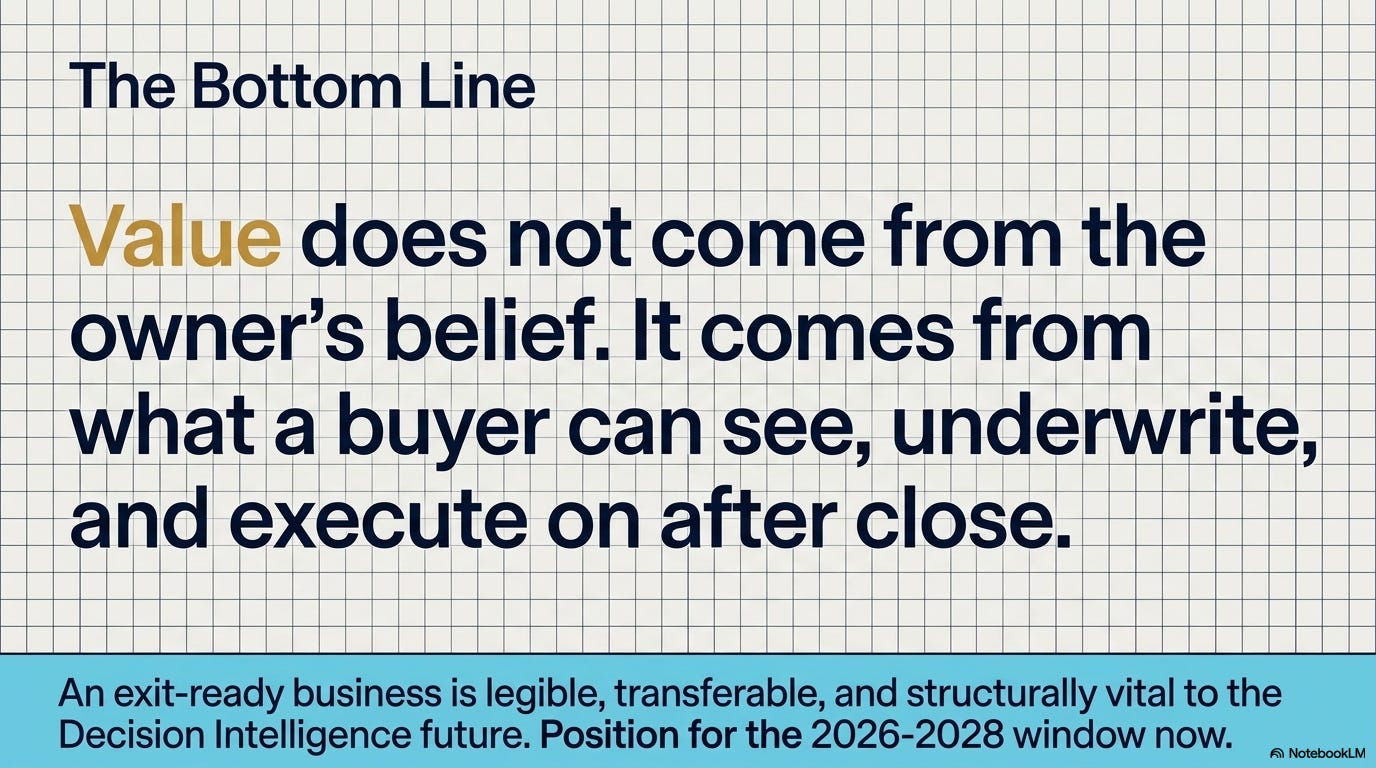
Fifty-four percent of business owners say their biggest fear when selling is not getting the value they believe the business is worth. But value does not come from the owner’s belief. It comes from what a buyer can see, underwrite, and execute on after close. The gap between what an owner believes the business is worth and what a buyer will pay for it is overwhelmingly a function of the work that was not done before the process started — not the process itself.
For insights industry leaders specifically, the most important version of this is the personal transition from operator to architect. The standard hub-and-spoke problem — owner at the center of revenue, relationships, and decisions — has a layer below it in this industry that rarely gets discussed directly: the owner’s relationship with the identity of the business as an extension of their own expertise and relationships.
Many of the best small and mid-sized suppliers in this industry are built around a founder whose methodological credibility, client network, and category reputation are genuinely irreplaceable. The business grew because of them. The challenge is that the same qualities that built the business are the qualities that make it less acquirable. A PE firm cannot buy a founder’s brain. It can only buy what the founder has built into a system.
The Decision Intelligence thread in our broader work returns to this repeatedly: the leadership transformation required is not just organizational. It is epistemic. Leaders who have been methodological experts need to become product architects. Leaders who have been client service experts need to become relationship system designers. Leaders who have been the creative center of the business need to become the coaches of a creative system that runs without them.
That is harder than cleaning up the financial statements. But it is the work that actually closes the gap between a 56 and an 80 on the readiness index — and the difference between a 3.0x median offer and the 5x+ range where premium buyers compete.
The Sequence That Matters
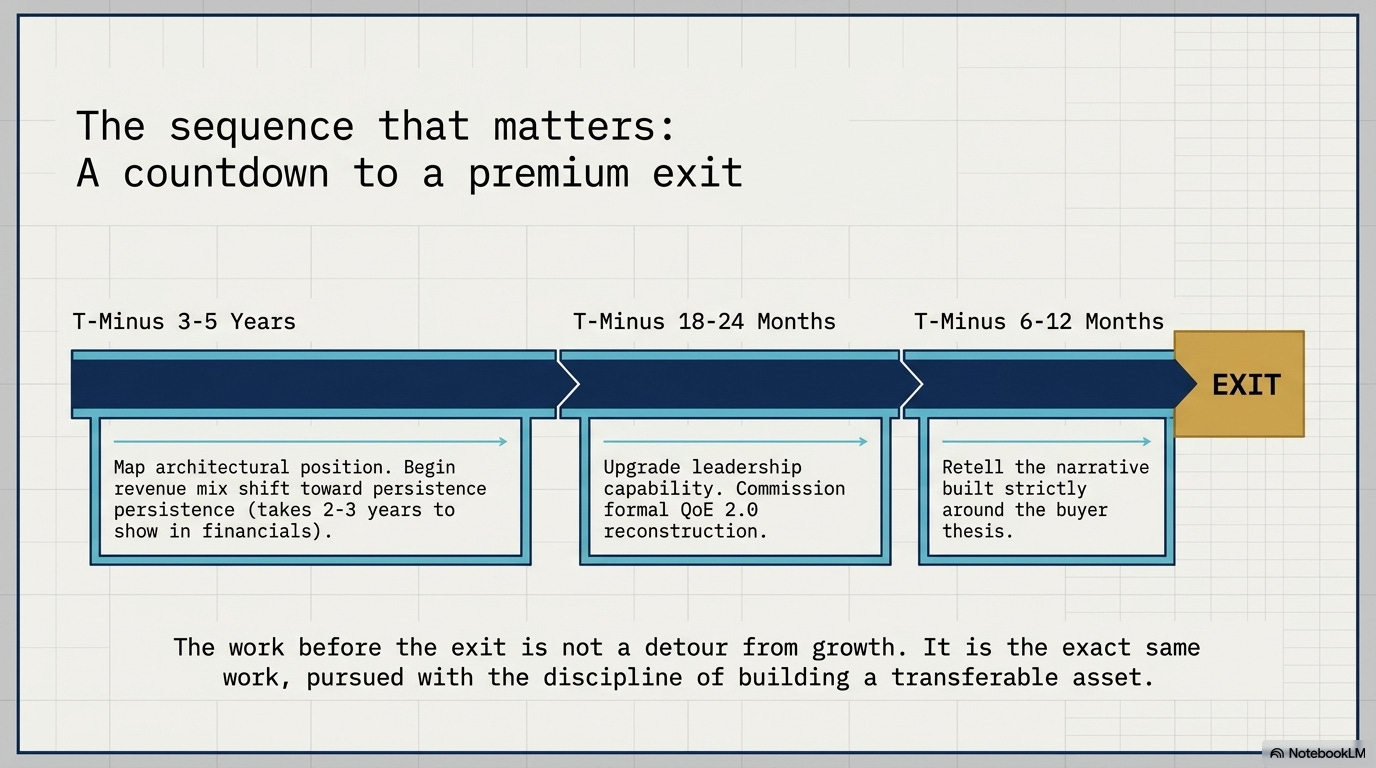
If you are leading a small to mid-sized insights supplier and you are thinking about a transaction in the next three to five years, the sequencing matters as much as the specific work items. Here is the honest version of how that sequence typically needs to run:
First, before anything else: Get clear on the architectural position. Decide what layer you own, what layer is the credible next step, and what data assets or capabilities anchor the claim. Without this, every operational improvement you make will be evaluated on the wrong thesis.
In parallel with architecture work: Begin the revenue mix transition. Every new client relationship should be structured to move toward recurring value delivery from the start. Existing relationships should be systematically evaluated for conversion. This takes two to three years to show up meaningfully in the financial architecture.
As the architecture clarifies: Build the management team for where the business is going, not where it has been. Hire the AI and data literacy, the product thinking, and the C-suite relationship capability that the next layer of the stack requires. Incentivize that team with equity that aligns them to the transaction value, not just the current operating model.
Eighteen to twenty-four months before the intended transaction window: Commission a rigorous quality of earnings exercise — not a traditional audit, but the QoE 2.0 reconstruction that disaggregates revenue by type, cohort, and margin. This exercise typically surfaces both value that was being obscured and risks that need to be addressed before they become due diligence discoveries.
Six to twelve months before: Retell the narrative. The business description, the financial summary, the growth story, and the strategic positioning materials should all be rebuilt around the buyer thesis — platform economics, proprietary data, decision layer proximity, and the architectural journey from current state to the point where the buyer completes the stack.
The Market Has Said It Clearly
The PE market has been saying the same thing for two years now, across multiple deal structures, acquisition theses, and investment mandates. It is not looking for more of the same. It is looking for assets that are misnamed, mispriced, and capable of being rebuilt into something structurally more valuable.
The density of unsolicited offers going to businesses that are not ready for them — the 21% of owners who received a written offer last quarter at a median of 3.0x — is not a sign of robust exit conditions. It is a sign of buyers doing prospecting at scale, hoping to find an asset worth paying for inside a sector they know is undergoing structural transformation.
The window where being positioned correctly produces a materially different outcome is the 2026 to 2028 period that the Decision Intelligence thesis has been pointing to. Not because the window closes hard after that, but because the platform positions are being established now — and once the architecture of the next generation of the industry is legible, the premium that accrues to the first movers will be harder and harder for later entrants to close.
The work before the exit is not a detour from growth. It is the same work as growth, pursued with an additional discipline: the discipline of building things that are transferable, legible, and worth more to a buyer than they are worth on a standalone basis.
That is what “exit-ready” actually means in this industry, at this moment.
This post is the third in an ongoing series on strategic positioning, PE dynamics, and the Decision Intelligence transition in the insights and analytics industry. Prior installments: The PE Market Just Told You and The Next Roll-Up Is Not a Roll-Up. Related reading from the IIV corpus: The Industry Is Being Redrawn. Here’s the Map. · The Data Infrastructure Layer Is Being Rebuilt · The Qualtrics Canary · The Future of Professional Services Is a Warning Shot for Market Research · Selling the Mine or Selling the Shovels? · Synthetic Sample Is Not the Market. Decision-Grade Data Is.