
Sometimes a single week’s news crystallizes months of signal into something undeniable. This is one of those weeks.
If you have been following along with our weekly analyses here on Substack, the Qualtrics story that broke last week should feel less like a surprise and more like a confirmation. We have been tracking the forces building toward exactly this kind of inflection point for months. Qualtrics, whether it intended to or not, just became the canary in the coal mine for the entire insights and analytics industry.
Let’s unpack what actually happened, why it matters, and what it tells us about where things are heading.
What Happened at X4
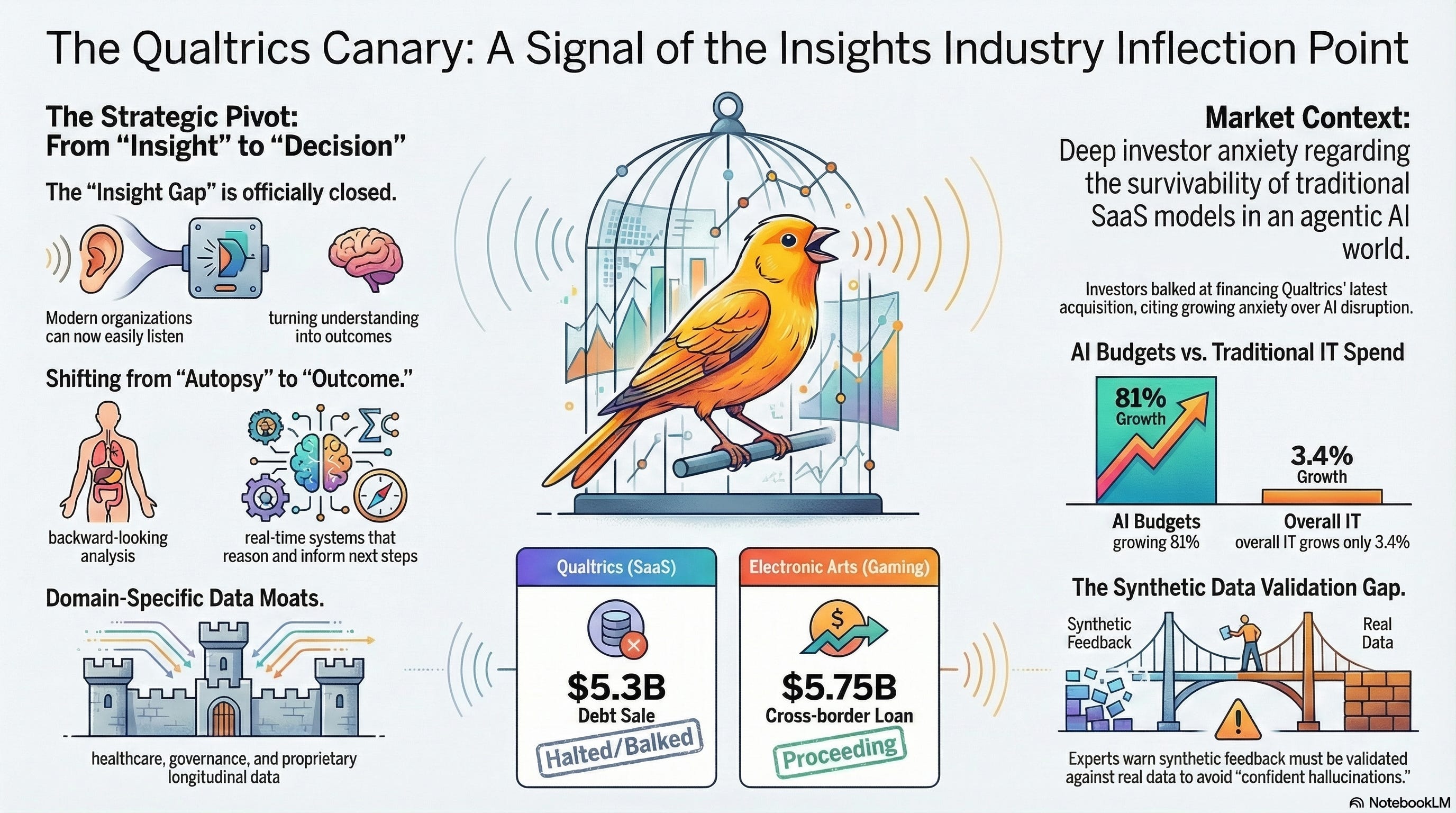
New CEO Jason Maynard took the stage at Qualtrics’ annual X4 conference in Seattle this week for his first major public outing since taking the job in February. His message was clear and, strategically speaking, correct: the “insight gap” that Qualtrics was built to solve is closed. Organizations can now listen across channels, understand why customers churn, and connect experience data to operational signals. That problem, as Maynard put it, has been largely solved.
The new gap, in his framing, is between understanding and outcomes. His exact words are worth quoting: “Knowing why something went wrong after it went wrong is not a competitive advantage anymore. It’s an autopsy. We don’t want that.” The pivot is from insight platform to what Maynard calls a “system of decision.” Not a system of record. Not a pure analytics layer. Something that reasons across systems using experience data to inform what happens next.
To support that pivot, Qualtrics announced a sweep of new capabilities at X4: synthetic panels for US consumers that the company claims are 12x more accurate than general-purpose AI in matching human responses, at half the cost of traditional panels; a Research Hub that transforms years of fragmented organizational research into a conversational answer engine; agentic AI that can close the loop with customers and employees at scale; and a Business Outcome Simulator that runs real-time “what-if” scenarios to attach dollar values to CX and research decisions.
The strategic direction is right. The argument that experience data is the missing context layer for effective agentic AI is compelling. “Without context, AI is fast and blind,” as Maynard said. That is a legitimate and differentiated value proposition.
And then the news broke.
The Debt Deal That Wasn’t
Literally at the moment Maynard was declining to comment on the company’s planned acquisition of Press Ganey Forsta, JPMorgan Chase and a group of Wall Street banks halted a $5.3 billion debt sale tied to Qualtrics’ $6.75 billion deal to buy the healthcare market research firm. Bloomberg and the Financial Times both reported it. Investors in the leveraged loan and junk-bond markets balked. One bond dealer was quoted as saying “software is a tough sell right now.”
The reasons given were specific and pointed. Investors cited concerns about Qualtrics’ future revenue prospects and, more directly, growing anxiety about whether AI could undermine the company’s core business model. Qualtrics’ existing $1.5 billion term loan has already fallen to trading around $0.86 on the dollar, down from near par in February. The banks may now be forced to hold the debt on their own balance sheets if market conditions do not improve.
The sardonic detail that crystallizes the moment: JPMorgan couldn’t place the $5.3 billion Qualtrics debt, but is proceeding with a $5.75 billion cross-border loan to fund the leveraged buyout of Electronic Arts. The same bank, the same week, same approximate size. Markets currently prefer a video game company to an enterprise survey software firm. That is a blunt statement about how sophisticated capital views the survivability of traditional SaaS platforms in an agentic world.
Why This Is the Canary
Here is what makes this moment so significant for everyone in the insights and analytics industry. Qualtrics is not a struggling company. It is owned by Silver Lake and the Canada Pension Plan Investment Board. It just held what it describes as the largest gathering of experience management professionals in the world. Its new CEO is sharp, its strategic direction is thoughtful, and its product announcements at X4 were substantive.
And capital markets are still pricing in the risk that AI disrupts it.
This is the structural tension we have been tracking in our weekly analyses since the fall. In our post on what 15 years of IIeX startup entrants tell us about the future of insights, we noted the shift from “clever methods” to “Insight OS” platforms. In our analysis of the “zero human insights company” question, we explored how agentic AI could reshape the entire value chain. Every week we have been watching AI capabilities, synthetic data, and agentic workflows accelerate while the underlying business models of established platforms remained largely unchanged. Qualtrics’ debt drama is what that tension looks like when it reaches the credit markets.
The SaaStr data from this week’s news summary makes the financial logic explicit: Anthropic and OpenAI now capture $40 to $50 billion in annual enterprise spend, AI budgets are growing 81 percent while overall IT grows only 3.4 percent, and as much as 70 percent of the software slowdown may be attributable to budget flowing from traditional SaaS vendors to foundation model providers. As the OpenAI Frontier story we covered this week put it, OpenAI is explicitly trying to become the enterprise intelligence layer above all existing tools, bypassing embedded vendor software to act as a unified layer across the entire stack. The per-seat SaaS model that has underpinned platforms like Qualtrics’ profitability is being challenged at its foundations.
The canary is not singing because Qualtrics made a mistake. It is singing because the mine itself is changing.
The Synthetic Data Credibility Problem
There is a second layer to this story that matters just as much for our industry.
Gartner analyst Michael Maziarka, speaking to CMSWire during the X4 coverage, offered the most important public guardrail on synthetic data claims we have seen from a major analyst firm. His position is direct: “Synthetic feedback should never replace real, observed customer VoC data. It can serve as a starting point for, and augment, real data.”
He went further, outlining five validation requirements that any CX or research leader should demand from any synthetic data vendor: data sourcing and quality, comparative testing against first-party VoC data, conclusion similarity testing, hallucination checks, and bias mitigation. Organizations that skip this validation layer, he warned, risk building decisions on simulations that feel confident but are not grounded in reality.
This comes in the same week that Samuel Cohen at Fairgen published what has become the most widely shared taxonomy post on the subject: “Synthetic data is doing too much work as a term”. It describes at least four distinct methods within market research scope, and the market is treating them as interchangeable. Kevin Karty’s cheat sheet on the same topic from the week prior reinforced the same point. The conflation of approaches is where bad research starts, and it is where governance failures will emerge.
We have been flagging this issue for weeks. Gartner is now saying it publicly during the biggest synthetic data product launch of the year from the category’s largest platform. That is the market saying there is a gap between the claims being made and the validation infrastructure that exists to substantiate them.
That gap is a risk. It is also an opportunity.
The Healthcare Angle That Deserves More Attention
There is a dimension of the Press Ganey deal that has been underappreciated in most of the coverage and is worth surfacing here, brought up in a discussion with our good friend Elaine Riddell of Oaklins | DeSilva+Phillips.
Qualtrics plus Press Ganey in healthcare is a genuinely impressive combination. Press Ganey works with over 41,000 healthcare providers across 30 countries. Qualtrics’ synthetic model applied to real-world evidence in pharma and healthcare is a materially different value proposition than general consumer experience surveys. Real-world evidence augmented by AI-enabled synthetic modeling is a multi-billion dollar market where the stakes, the defensibility, and the regulatory context are all fundamentally different from enterprise CX.
The investor skepticism around the debt deal has focused on the software rout and AI disruption risk. But the healthcare and biopharma angle may represent exactly the kind of deep, defensible, domain-specific data moat that survives the commoditization of general-purpose AI capabilities. If Qualtrics can credibly reframe the Press Ganey acquisition as a healthcare AI data platform play rather than a scale CX deal, the investor story changes meaningfully.
This is consistent with something we have been saying for months about where defensible moats are being built: they are in proprietary longitudinal data in high-stakes domains, in governance and validation infrastructure, and in the irreplaceable human judgment that sits at critical decision points. The healthcare data asset in this deal may be the most undervalued component of the entire transaction.
What This Means for the Rest of Us
Qualtrics is large enough and visible enough that its situation clarifies what many players in this industry are navigating quietly. The implications run across every segment.
For research technology suppliers, the debt drama is a preview of how capital will evaluate every platform in the next cycle of M&A and financing. The question investors are asking is not “does this company have AI features?” It is “does this company have a defensible reason to exist in a world where the intelligence layer is increasingly provided by OpenAI, Anthropic, or Google?” Platforms that can answer that question with proprietary data, governance infrastructure, or deep domain integration will attract capital. Those that cannot will face the same skepticism.
For research service firms, Maynard’s “insight is the autopsy” framing is not just a product pitch. It is a market signal. The category leader is telling buyers that insight alone is no longer sufficient as a deliverable. Service firms that are still selling insight as the primary product need to hear this clearly and respond with concrete ways to attach their work to outcomes, decisions, and measurable business results. The IIeX Start-up Competition retrospective we published is directly relevant here: the shift from clever methods to intelligence infrastructure is not coming. It is happening now.
For sample suppliers, the synthetic data questions Gartner is now raising publicly are an opening. The five validation requirements Maziarka outlined are not hypothetical. They are what your buyers will start asking for. The suppliers who have the quality infrastructure, the first-party data, and the independent certification processes to answer those questions will be positioned as trusted partners. Those who do not will be commoditized by the very synthetic platforms that are supposed to complement them.
For consultancies, the “system of decision” ambition Maynard articulated at X4 is the right frame for where advisory value lives right now. The companies that win in the next phase are the ones that can help their clients redesign organizations and processes around AI, attach experience and insight data to financial outcomes, and govern the synthetic and agentic tools they are deploying. The governance gap is real, the “last mile” problem is real, and there is significant unmet demand for practical help navigating both.
The Gaps Are Becoming Visible
One of the most valuable things that happens when a large, visible player faces a public moment of tension is that it illuminates the white spaces. The Qualtrics situation makes clear that there are real gaps in the market that have not been filled.
The validation and provenance layer that Gartner is calling for does not exist as an independent, platform-agnostic infrastructure. The governance tools that help organizations make sense of what they are actually buying when they buy synthetic data are not standardized. The business outcome measurement frameworks that bridge insight and financial accountability are still being assembled. The orchestration layer that could sit above fragmented agentic tools and provide human-governed workflows with audit trails is nascent.
None of these gaps will stay empty for long. The market signals are too clear and the demand too obvious. The interesting question is whether they get filled by the established players moving up the stack, by new entrants building from scratch with a cleaner architecture, or by the foundation model providers who are already positioning to become the intelligence layer above everything else.
The Bottom Line
Qualtrics is not a cautionary tale. It is a leading indicator. A company with sophisticated owners, a sharp new CEO, an impressive product roadmap, and a defensible strategic thesis still faces a capital market that is pricing in the possibility that AI makes its existing revenue base indefensible. That is the stakes of the current transition, stated plainly.
The right response to that signal is not panic. It is clarity. Clarity about where your defensible moats actually are. Clarity about the difference between AI as a feature bolt-on and AI as an operating layer. Clarity about what “insight” means when the category leader is publicly declaring it insufficient. And clarity about the governance and validation infrastructure that has to exist for any of this to be trustworthy enough to build decisions on.
We have been building toward that clarity in these weekly analyses. This week’s news from Seattle is evidence that the transition we have been tracking is not hypothetical. It is here, it is moving fast, and it is starting to show up in credit markets.
The canary is singing. The question is whether we are listening.
If you have found these analyses useful, subscribe for free to receive them directly in your inbox. And if you want to go deeper on the themes we are tracking, take a look at our recent posts: From Hacks to Infrastructure: What 15 Years of Insight Startups Reveal About Where We Go Next and What Would a Zero Human Insights Company Actually Look Like?
References
1. Qualtrics X4 - new CEO Jason Maynard declares the insight gap ... - At his first X4 summit, new Qualtrics CEO Jason Maynard declared the insight gap closed and made the...
2. Qualtrics Names Jason Maynard CEO - Futurum Research - Qualtrics appoints Jason Maynard CEO. We examine leadership, product focus, and the implications for...
3. Qualtrics X4 2026: AI Agents, Synthetic Panels and More - CMSWire - At its Seattle conference, the company introduced faster omnichannel deployment, automated text anal...
4. JPMorgan Halts $5.3B Qualtrics Debt Sale as AI Concerns Weigh - Banks pause financing for Qualtrics’ $6.75B deal after weak investor demand and discounted secondary...
5. JPMorgan Halts Qualtrics $5.3 Billion Debt on Software Pain - A group of banks led by JPMorgan Chase & Co. halted a $5.3 billion debt deal for Qualtrics Internati...
6. Key facts: JPMorgan pauses $5.3B Qualtrics debt; Combs oversees ... - JPMorgan Chase led banks pausing syndication of about $5.3B debt tied to Qualtrics’ $7B Press Ganey ...
7. Back-to-back Qualtrics, EA debt sales to test debt investors ... - WHBL - ... Press Ganey Forsta in a $6.75 billion deal. It is being financed largely by a $5.3 billion debt...