
This post is the direct sequel to Decision as a Service: The Architecture That Changes Everything. It continues the structural series that has run through The Future of Professional Services Is a Warning Shot for Market Research, The Data Infrastructure Layer Is Being Rebuilt, Synthetic Sample Is Not the Market. Decision-Grade Data Is., The Industry Is Being Redrawn. Here’s the Map., and Self-Serve Is Not a Category Anymore. It Is a Capability.
The Conversation Continues
After the last post, Jeff Krentz — the capital markets professional whose text message originated the “Decision as a Service” label — came back with three questions that cut straight to the heart of the implementation problem:
“How do you get from an entrenched business model to Decision as a Service? What are objective measures around the quality of the decision? And how does the model account for the importance of the decision — the big senior-level ones and the thousands of daily routine decisions?”
And Elaine Riddell, who has spent her career building value-based models in the insights space, added the market data point the conversation needed:
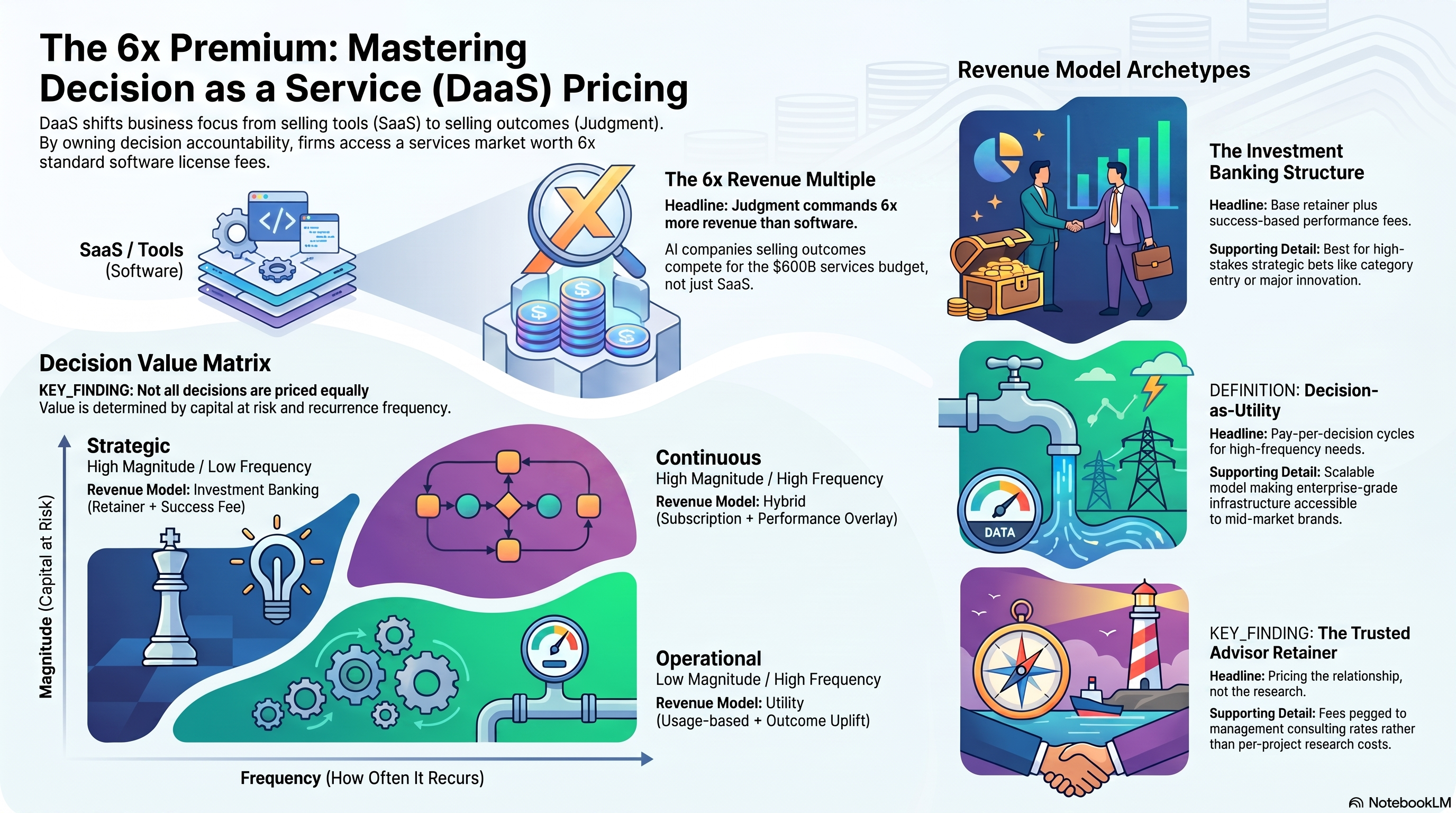
“A Sequoia partner reinforced the transition from SaaS to ‘Managed Services’ or ‘Decision-as-a-Service.’ There is 6x revenue for ‘Judgement’ vs. the license fee for ‘Software’ only. The ‘Consulting’ or ‘Judgement’ layer generates significant revenue.”
Then she gave it the right commercial framing: “I think the pricing isn’t by decision but rather the expected impact/outcome for the brand. Perhaps it’s a bit like the investment banking model — Minimum Fee (50% to 75% of total value paid monthly in advance) + Success/Performance Fee by quarter.”
Jeff and Elaine are part of the IIV “Brain Trust” and good friends, and this dialogue underscores why.
This post takes those three questions seriously and works through the pricing architecture that makes Decision as a Service a viable business — not just a compelling concept.
The 6x Number Is the Strategic Anchor
Let’s start with Elaine’s Sequoia reference, because it reframes the entire commercial opportunity.
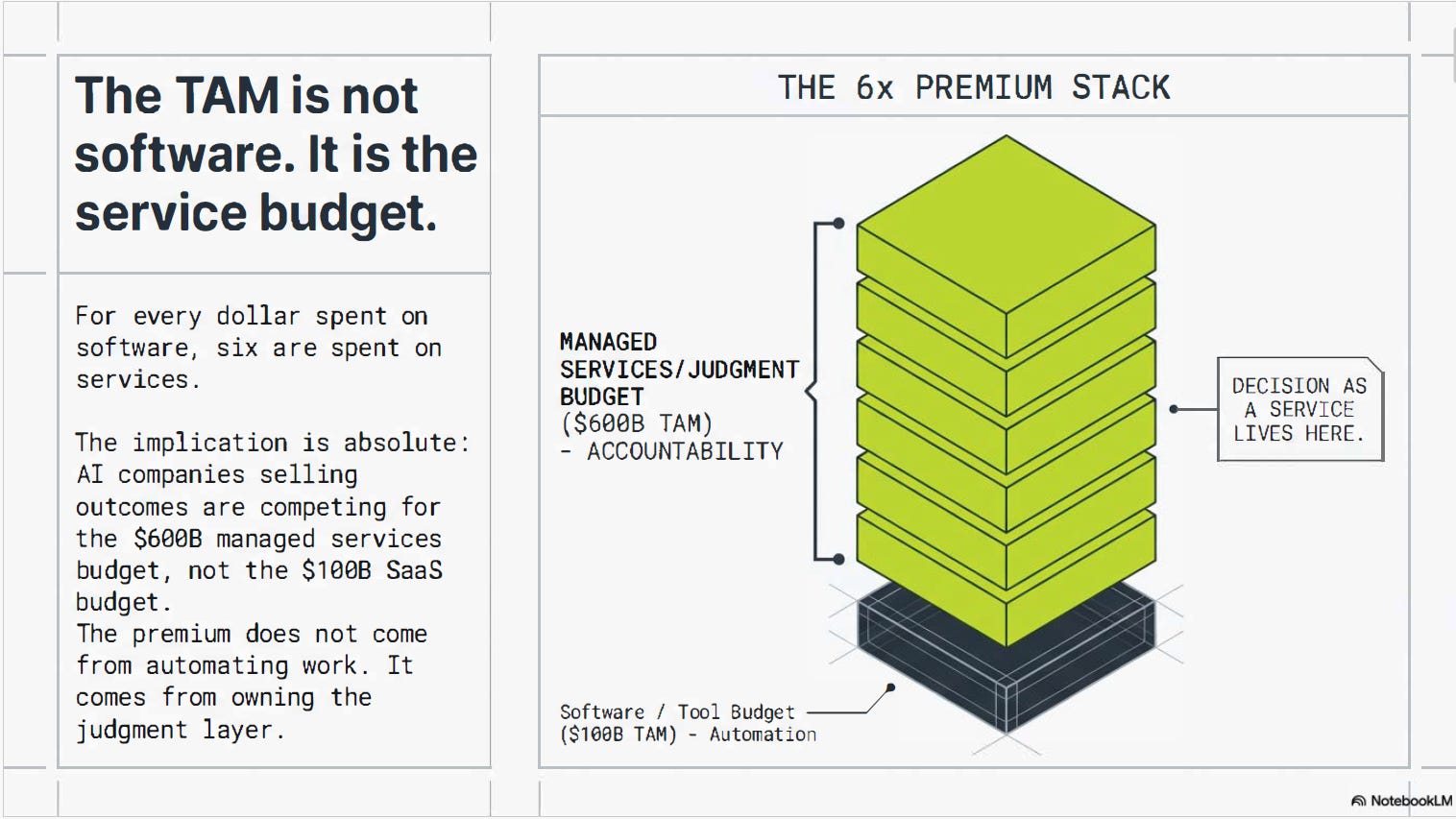
In March 2026, Sequoia published “Services: The New Software,” a structural analysis of the AI services market. The core argument: for every dollar spent on software, six are spent on services. The implication is direct — AI companies that sell outcomes rather than tools are competing for the services budget, not the software budget. The TAM is not $100B in SaaS. It is $600B in services spend that currently flows to human professionals.
Sequoia’s intelligence/judgment distinction is the critical conceptual tool here. Intelligence work — translatable into rules, codifiable, improvable through scale — can be automated. Judgment work — requiring accumulated experience, pattern recognition built on years of context, trust earned through track record — is harder to automate and commands a premium precisely because it is scarcer.
The insight for the DaaS pricing architecture: the 6x premium does not come from automating the work. It comes from owning the judgment layer on top of the automated work. A decision infrastructure that surfaces the right answer efficiently is automation. A decision infrastructure that accepts accountability for the decision — that puts its professional credibility and its revenue at stake alongside the client’s capital — is judgment. The first captures the tool budget. The second captures the service budget.
Mayfield’s Navin Chaddha has called this transition the “Cognition-as-a-Service” era — the next abstraction layer above IaaS, PaaS, and SaaS — where pricing moves completely toward outcome-based models: “You improve my productivity by X, I give you Y. You improve my revenues by A, I give you B.” His firm’s prediction: AI teammates could capture approximately $6 trillion of the $30 trillion global white-collar labor market within five to seven years. The decision layer is where the most defensible portion of that $6 trillion concentrates.
The Three Problems Jeff Identified Are Really One Problem
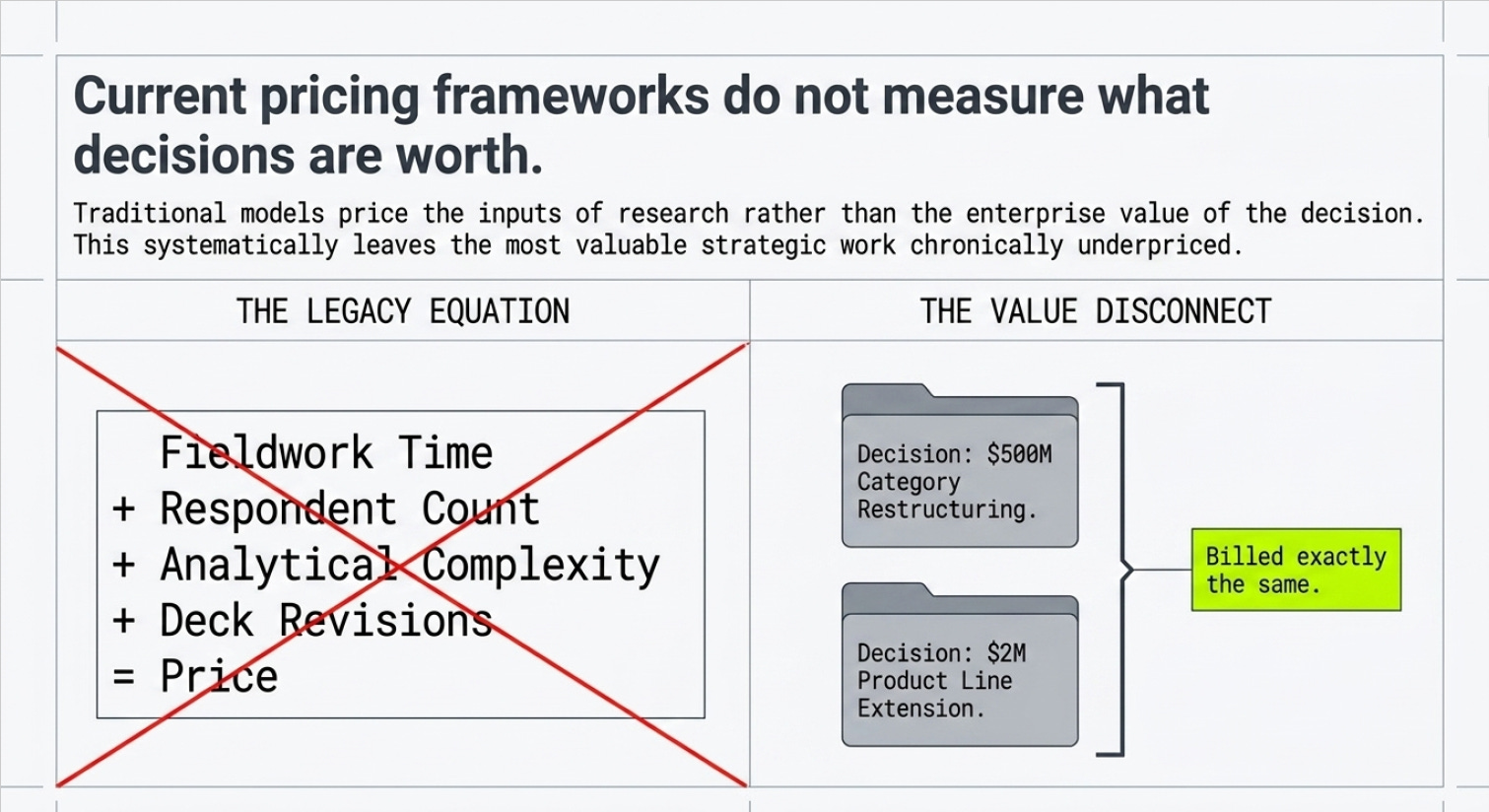
Jeff’s three questions — migration from entrenched models, measuring decision quality, and differentiating by decision importance — are all expressions of a single underlying challenge: current pricing frameworks do not measure what decisions are worth.
Traditional market research pricing measures inputs and processes:
How long will the fieldwork take?
How many respondents?
What analytical complexity?
How many revisions to the deck?
None of that measures what the decision that results is actually worth to the brand. A pricing study that informs a category restructuring worth $500M is billed the same way as a pricing study that informs a $2M product line extension. The methodology is the same. The value is orders of magnitude different. And the entire project fee model systematically leaves the most valuable work in the industry chronically underpriced.
Decision as a Service forces the industry to confront this directly — and that confrontation, uncomfortable as it is, is where the 6x multiple lives.
A Taxonomy of Decisions: Why Importance and Frequency Are Both Pricing Variables
Jeff’s second insight — that the model must account for the difference between a major strategic decision and thousands of daily routine ones — leads directly to the first structural element of any DaaS pricing architecture.
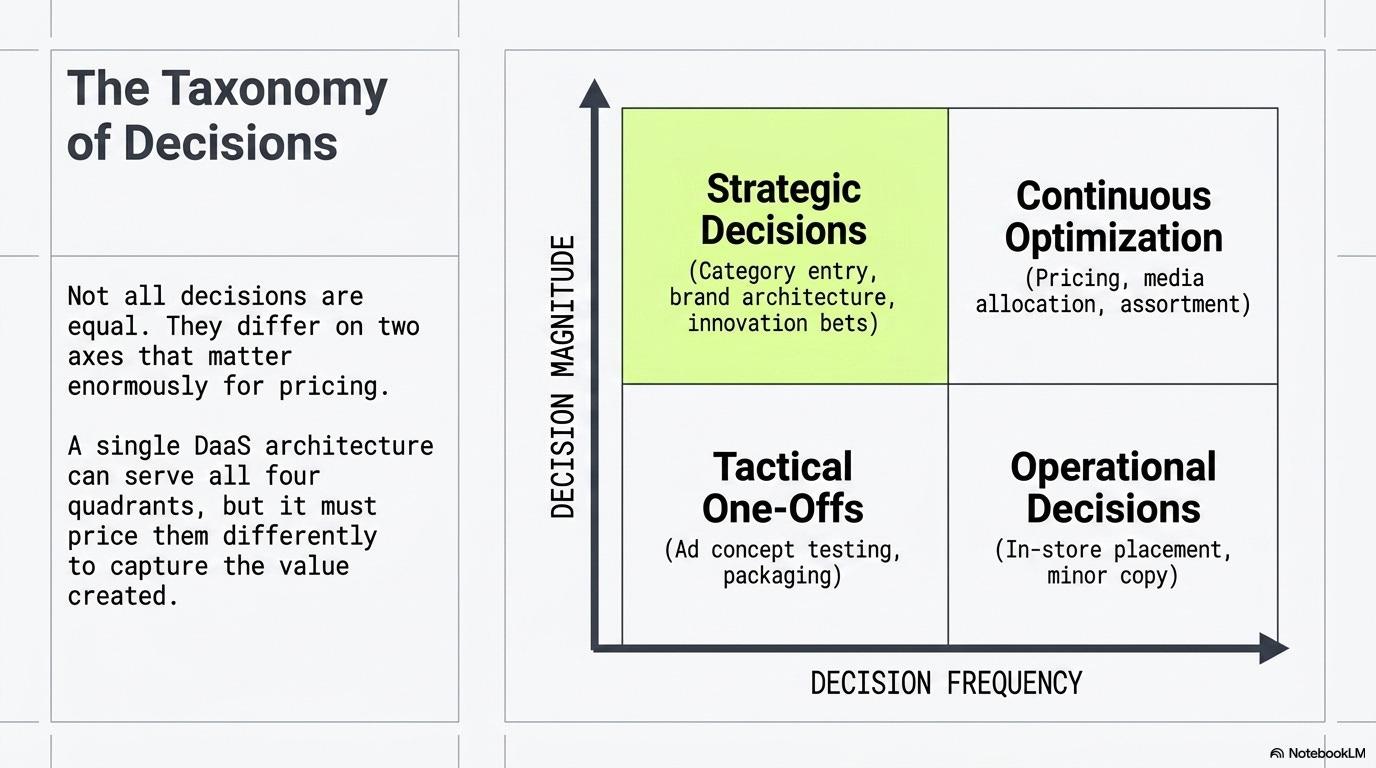
Not all decisions are equal. They differ on two axes that matter enormously for pricing:
Decision Magnitude: the capital at risk, the organizational irreversibility of the outcome, and the strategic horizon. A brand architecture decision that sets portfolio strategy for five years is not the same as a weekly media allocation optimization.
Decision Frequency: how often the decision recurs and how much of the total decision value comes from compounding consistency over time versus getting the single-high-stakes call right.
Plot those two axes and you get a four-quadrant decision map that should drive every pricing conversation:

The pricing model for each quadrant is structurally different. Low-frequency, high-magnitude strategic decisions command the investment banking fee model Elaine describes. High-frequency operational decisions command the SaaS subscription or usage model. The innovation of DaaS is that a single architecture can serve all four quadrants — but it must price them differently to capture the value it creates in each.
Four Revenue Model Archetypes for DaaS
No single pricing model works across all four quadrants, across all client sizes, or across the full DaaS maturity curve. What follows are four archetypes, drawn from adjacent industries that have already navigated this transition, and their application to the insights context.
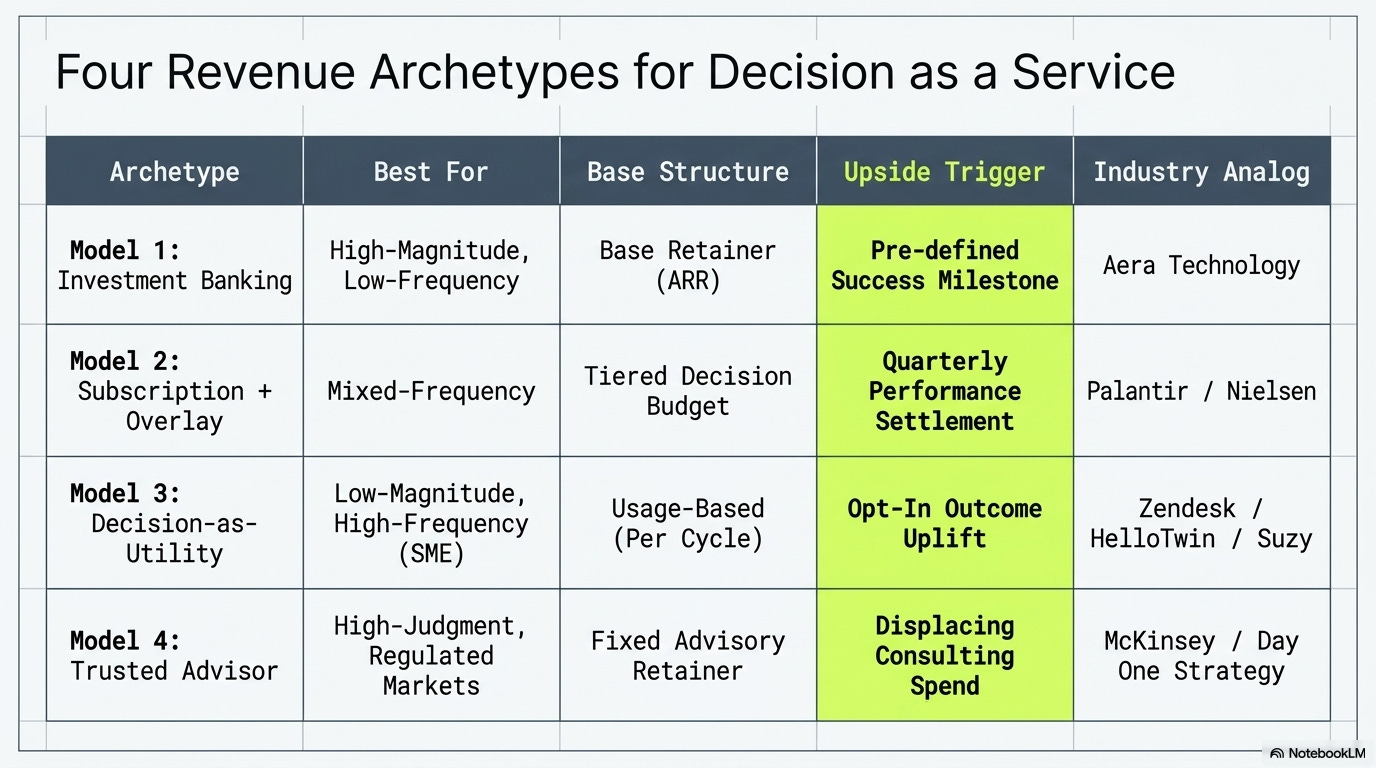
Model 1: The Investment Banking Structure
Best for: High-magnitude, low-frequency strategic decisions
Elaine’s analogy is exactly right for this quadrant. Investment banks charge a minimum retainer — typically 50–75% of total expected fees, paid monthly in advance — plus a success or performance fee triggered by a measurable milestone.
In the DaaS context, the structure maps as follows:
Base Retainer: Covers the infrastructure, the Decision Ontology maintenance, the data access, and the ongoing intelligence layer. Priced at a level that ensures operating margin regardless of decision frequency. This is the ARR component — the stable, predictable revenue base that satisfies the financial model.
Success/Performance Fee: Triggered by a measurable business outcome attributable to the decision. A pricing optimization decision that demonstrably recovers 3% of margin: a percentage of the recovery. A launch decision that outperforms category benchmarks by a defined threshold: a fixed fee or percentage of incremental revenue.
The critical design requirement: the success metric must be defined before the decision is made, agreed upon by both parties, and measurable by a third-party data source — ideally the same verified human behavioral data the DaaS system used to make the recommendation in the first place. This closes the accountability loop. The provider cannot move the goalposts after the fact, and the client cannot deny credit when the outcome is clearly attributable.
Who does this well today: Investment banks (obviously), management consulting firms on certain transformation engagements, and early-stage DaaS players in supply chain and procurement where outcome measurement is cleaner. Aera Technology (now backed by Accenture) is the most visible production example in the operational enterprise space.
Model 2: Decision-Tier Subscription + Performance Overlay
Best for: Mixed-frequency clients with decisions across multiple quadrants
This is the hybrid model that maintains ARR stability while creating upside aligned to value delivered. It operates on two levels simultaneously:
Tiered Infrastructure Subscription: Annual or quarterly license that provides access to the DaaS platform, the Decision Ontology, and a defined number of decision cycles per tier. Think of it as a “decision budget” — priced based on the number and category of decisions included. Tier 1 covers operational decisions (high frequency, lower magnitude). Tier 2 adds category-level strategic decisions. Tier 3 includes full portfolio strategic advisory.
Performance Overlay: On top of the subscription baseline, a variable component tied to verified performance improvement. This is not a success fee per individual decision — it is a quarterly or annual performance settlement tied to a composite outcome metric (brand equity index, category share, media ROI, margin recovery) against a pre-agreed baseline.
The performance overlay serves two functions. First, it aligns incentives — the DaaS provider is paid more when the system produces better decisions, which creates a continuous improvement loop in the model itself. Second, it allows the base subscription to be priced at a level that is accessible to a broader client set while preserving the 6x premium for clients where the system is genuinely producing board-level decision value.
Who does this well today: Palantir operates a close analog — base platform fees plus deployment fees plus outcome-linked components on certain government and commercial contracts. This is also the structure behind Nielsen’s legacy measurement + advisory model, though without the performance component.
Model 3: Decision-as-Utility (Usage + Outcome)
Best for: High-frequency, lower-magnitude decisions and the SME market
This is the model that makes DaaS accessible below the enterprise CPG tier — and it is the commercial architecture that HelloTwin, Suzy, and similar platforms are building toward. The pricing analog is the utility bill or the cloud infrastructure invoice: you pay for what you use, calibrated to the value of what you produced.
In practice, this means:
Usage-Based Base: Per decision-cycle, per agent-run, or per decision category per month. Low entry cost, no long-term commitment, accessible to brands that cannot justify an enterprise contract.
Outcome Uplift: Optional performance component triggered when the DaaS system’s recommendations produce a measurable improvement above the client’s own historical baseline. Because this layer is triggered by the client’s choice to verify and attribute, it can be offered as opt-in rather than required — which reduces the sales friction while preserving the revenue upside for the provider.
This model mirrors what Zendesk has built for its AI agents — priced per automated resolution, paying only for a customer interaction successfully handled without human intervention. The insight for DaaS: define the “resolved” state for a decision (the recommendation was acted on, the outcome was measured within a defined window, the result was above threshold) and you have the same pricing mechanism applied to a different category of work.
The SME unlock: At the usage-based tier, the minimum viable commitment is low enough that a $50M CPG brand can access the same Decision Ontology infrastructure that a $5B brand uses. The architecture scales. The pricing scales with it. This is the market gap identified in the first post — and it is the gap HelloTwin, Suzy, and quantilope are best positioned to fill if they build the outcome verification layer.
Model 4: The Trusted Advisor Retainer
Best for: Clients in early DaaS adoption, high-judgment domains, regulated markets
Hannah Mann’s point — from her Greenbook article on being a decision partner, not a supplier of work — frames this model precisely. The transition from “supplier of research” to “partner in decisions” is not just a positioning shift. It is a pricing model shift.
The Trusted Advisor Retainer is the commercial acknowledgment that, at the highest levels of the decision stack, the relationship is the infrastructure. A board-level decision about whether to enter a new category, whether to restructure a brand portfolio, or whether to exit a geography is not made by running an analysis and presenting a slide. It is made through a sustained relationship with someone who knows the business, has built calibrated judgment about the category, and has earned the right to be in the room when the call is made.
This model prices the relationship as the product: a fixed monthly or quarterly retainer for continuous advisory access, with the AI-powered decision infrastructure operating as the evidence layer underneath the advisor’s judgment. The human expert does not replace the AI. The AI does not replace the human expert. The combination — verified data, domain-trained model, and trusted human judgment applied to the output — is the product.
The pricing implication: The retainer should be priced not against the cost of the research it replaces, but against the cost of the management consulting engagement it displaces. A McKinsey or Bain engagement for a category strategy runs $500K–$2M. A DaaS trusted advisor retainer that delivers equivalent strategic decision support on a continuous basis, grounded in verified consumer intelligence, should price in that range — not in the $50K–$150K range of the research projects it technically subsumes.
This is the direct expression of the 6x premium. The tool budget is the research spend. The service budget is the consulting spend. The Trusted Advisor Retainer captures the consulting spend.
The Measurement Problem: How Do You Know the Decision Was Good?
Jeff’s point about objective measures of decision quality is the hardest unsolved problem in this architecture — and it deserves a frank answer rather than a side-step.
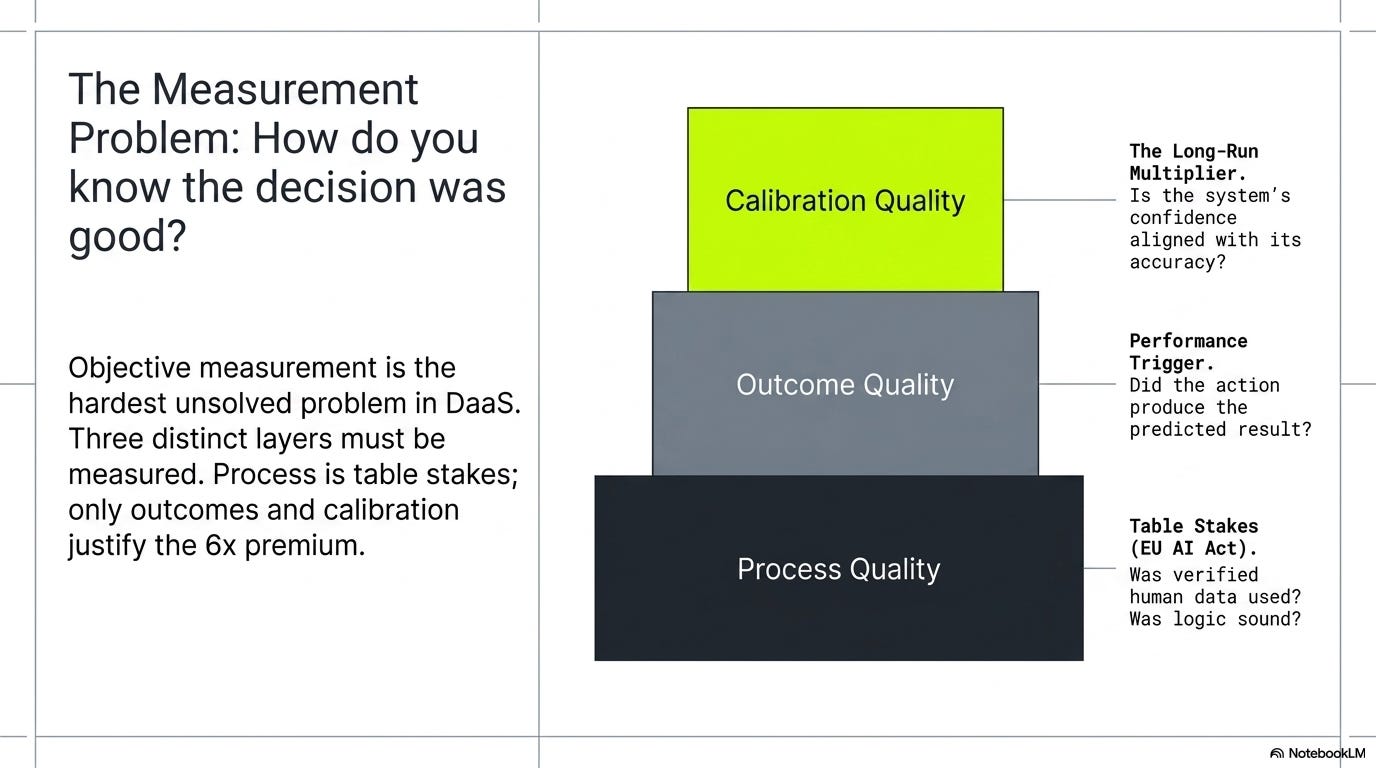
Three distinct things need to be measured, and they are not the same:
1. Decision Process Quality: Was the right information used? Was the decision logic sound? Was the uncertainty appropriately characterized? This is measurable now — it is what the Decision Ontology’s governance layer is designed to document. A decision is “process-quality” if it was made from verified human data, using a governed and audited methodology, with explicit confidence intervals communicated to the decision-maker. The EU AI Act’s requirements, fully applicable as of August 2026, essentially mandate this layer for AI systems used in consequential enterprise decisions.
2. Decision Outcome Quality: Did the recommended action produce the predicted result? This is measurable in arrears, against the same data systems that generated the recommendation. A pricing decision that predicted 3% margin recovery and delivered 2.8% is a high-quality outcome. The same decision that predicted 3% and delivered -1% is a poor outcome — whether the fault lies in the model, the execution, or an intervening market event is the attribution question that needs to be pre-specified in the contract.
3. Decision Calibration Quality: Over time, is the system’s confidence well-calibrated to its actual accuracy? A system that says “80% confidence” and is right 80% of the time is well-calibrated. A system that says “80% confidence” and is right 55% of the time is systematically over-confident and should be trusted less. Calibration quality is the long-run measure that institutional buyers should be asking about, and almost nobody in the current market is publishing this data. The first DaaS provider to publish a calibration track record — and hold themselves commercially accountable to it — will own the trust architecture that the entire market is trying to build.
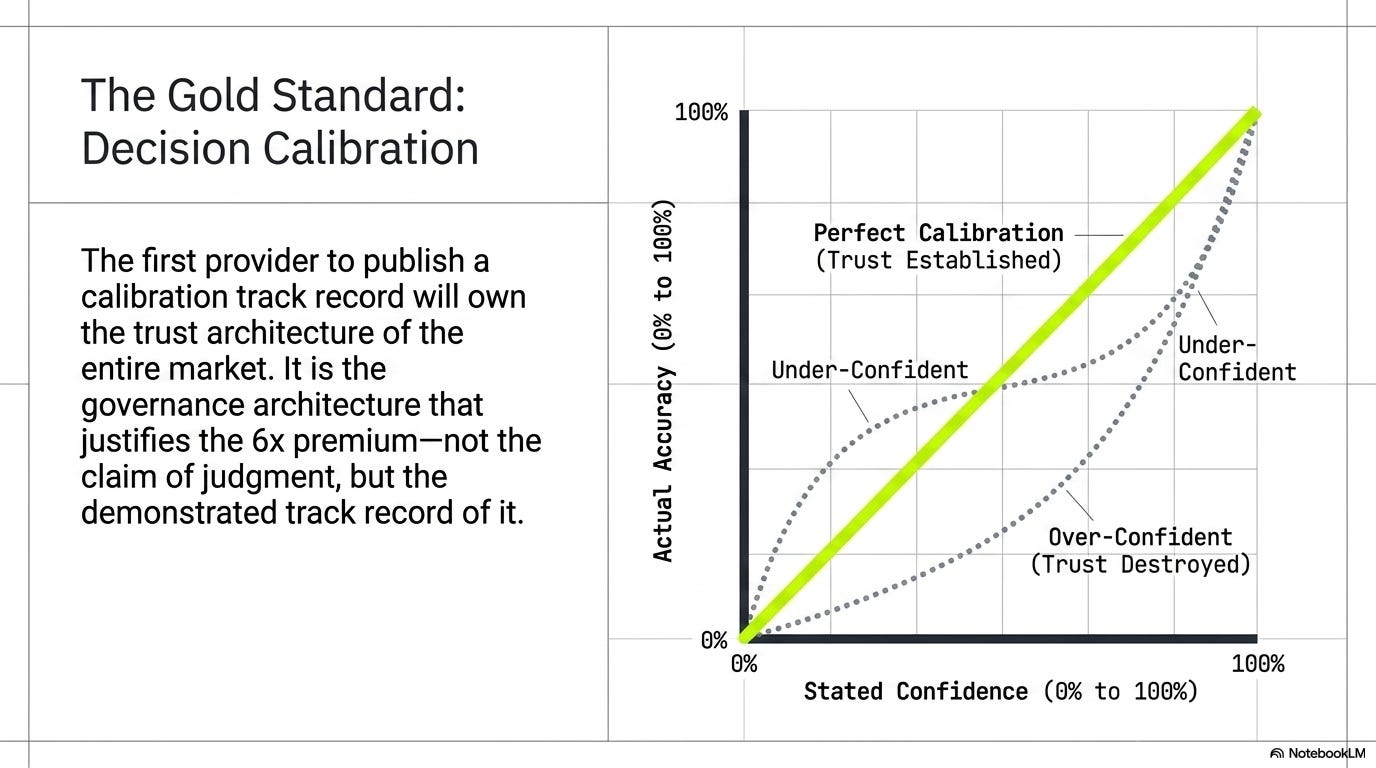
The practical implication for pricing design: only Decision Outcome Quality and Decision Calibration Quality should trigger performance fees. Process quality is table stakes — it is the prerequisite for being in the market, not a differentiator within it. The performance overlay should be tied to Outcome Quality (verified by the same independent data systems that generated the recommendation) and the base retainer should compound over time as Calibration Quality is demonstrated.
This is the governance architecture that justifies the 6x premium. Not the claim of judgment. The demonstrated track record of calibrated judgment.
The Migration Path: Getting From Here to There
Jeff asked how you get from the entrenched project-fee model to Decision as a Service. The honest answer is: not quickly, and not all at once. But there is a migration path that captures increasing value at each stage without requiring a full commercial model transformation in year one.
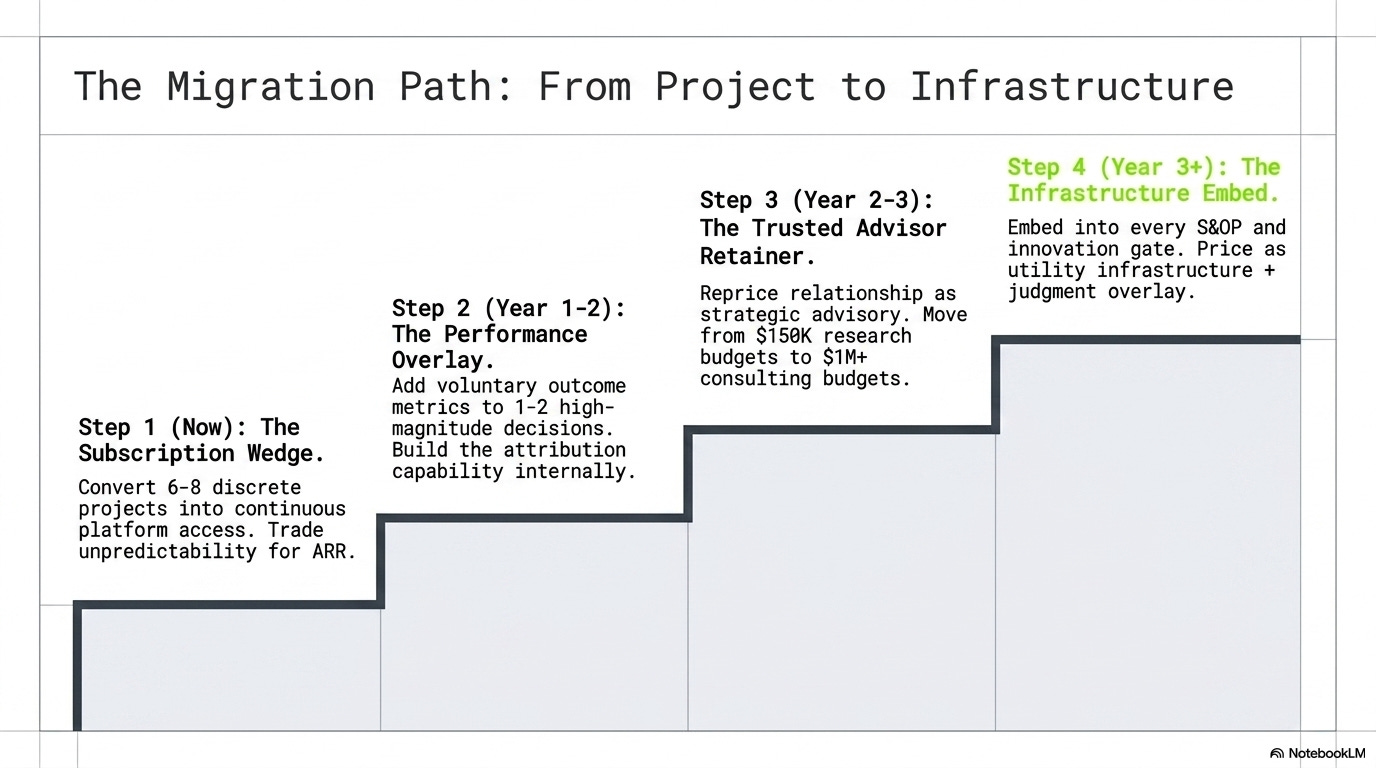
Stage 1: The Subscription Wedge (Now)
Sell continuous access to the decision intelligence platform at a fixed annual fee. This is the existing SaaS model, but priced against the full research spend being displaced rather than against the cost of a single study. The client moves from 6–8 discrete project engagements per year (paid on delivery, unpredictable budget timing) to one continuous contract (predictable, recurring, easier to renew). For the supplier, ARR replaces project revenue, which transforms the financial model and the valuation multiple.
Stage 2: The Performance Overlay (Year 1–2)
Add a voluntary performance component to one or two high-magnitude decisions per year. Define the outcome metric. Set the baseline. Agree on the attribution methodology. Charge a base fee plus a modest performance component. This builds the track record of calibrated judgment that justifies the larger performance fee in the next stage. Critically, it also forces the organizational capability-build internally — the supplier needs measurement systems, attribution models, and contract language that most current research firms do not have.
Stage 3: The Trusted Advisor Retainer (Year 2–3)
Once the track record exists, reprice the relationship as strategic advisory rather than research delivery. The monthly retainer replaces the per-project billing. The performance fee replaces the project markup. The total contract value increases to the $500K–$2M range for major clients. The supplier is now competing with management consulting firms for budget, not with other research firms.
Stage 4: The Decision Infrastructure Embed (Year 3+)
The DaaS system is embedded in the client’s workflow infrastructure — present at every weekly business review, every S&OP meeting, every innovation gate. The pricing moves to a licensing model for the infrastructure layer (like Cisco’s network software) plus outcome-linked components for identified high-value decision cycles. The client is no longer purchasing a service. They are operating a decision system that is priced like utility infrastructure with a performance overlay for the judgment layer above it.
The Trust Architecture Is the Revenue Architecture
Every pricing model described above has a single structural prerequisite: the client must trust the output enough to act on it and attribute the result.
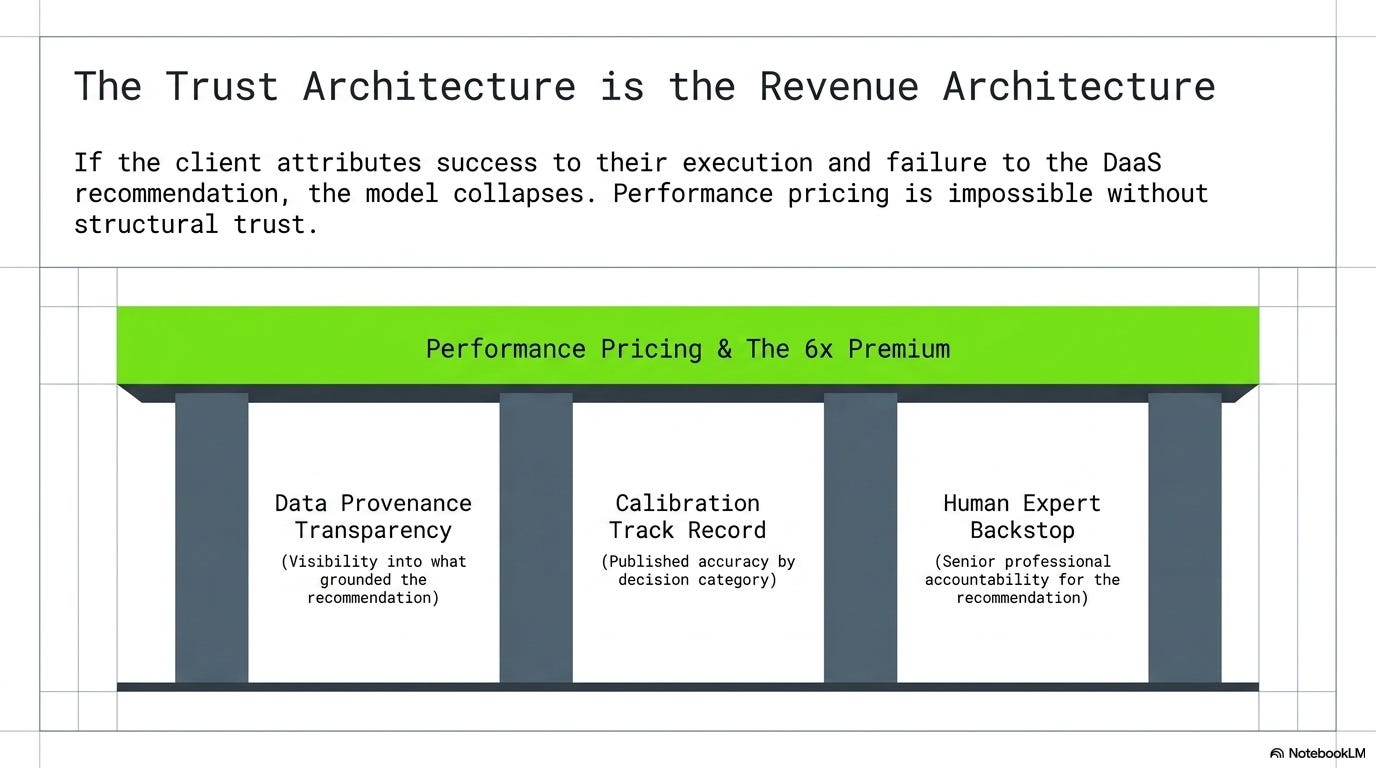
This is why Elaine’s comment — “core to this is the judgment layer, is ‘trust’ — a trusted advisor” — is not a soft claim about relationships. It is a hard claim about the only condition under which performance pricing works. If the client attributes their success to their own execution and their failure to the DaaS system’s bad recommendation, the performance fee becomes a source of conflict rather than a mechanism of alignment. The entire model collapses.
The trust architecture has three foundations, all of which need to be in place before performance pricing can scale:
1. Data Provenance Transparency: The client must be able to see, at any time, what data grounded the recommendation, how it was validated, and when it was last updated. This is not a nice-to-have — it is the governance requirement that makes a CEO willing to stake a capital allocation on the output of an AI system.
2. Calibration Track Record: The DaaS provider must maintain and publish a running record of their recommendation accuracy, by decision category and confidence tier. This does not exist in the current market. The first provider to build it owns the category’s trust infrastructure.
3. The Human Expert Backstop: The most valuable decisions will always involve a senior professional who knows the client’s business deeply, can contextualize the model’s output against strategic context the model cannot capture, and who is personally accountable for the recommendation. That person is not replaced by the DaaS system. They are empowered by it. And the pricing of their judgment — not the tool they use, but the quality of the judgment they exercise using the tool — is where the 6x premium lives.
Day One Strategy’s model — amplifying expert human judgment with purpose-built technology to help healthcare clients make confident, high-stakes decisions — is the precise expression of this architecture in a regulated, high-judgment domain. The technology is the infrastructure. The human expert judgment is the product.
What This Means for the Business Case
The financial logic of Decision as a Service, when the pricing architecture is right, is compelling from both sides of the transaction.
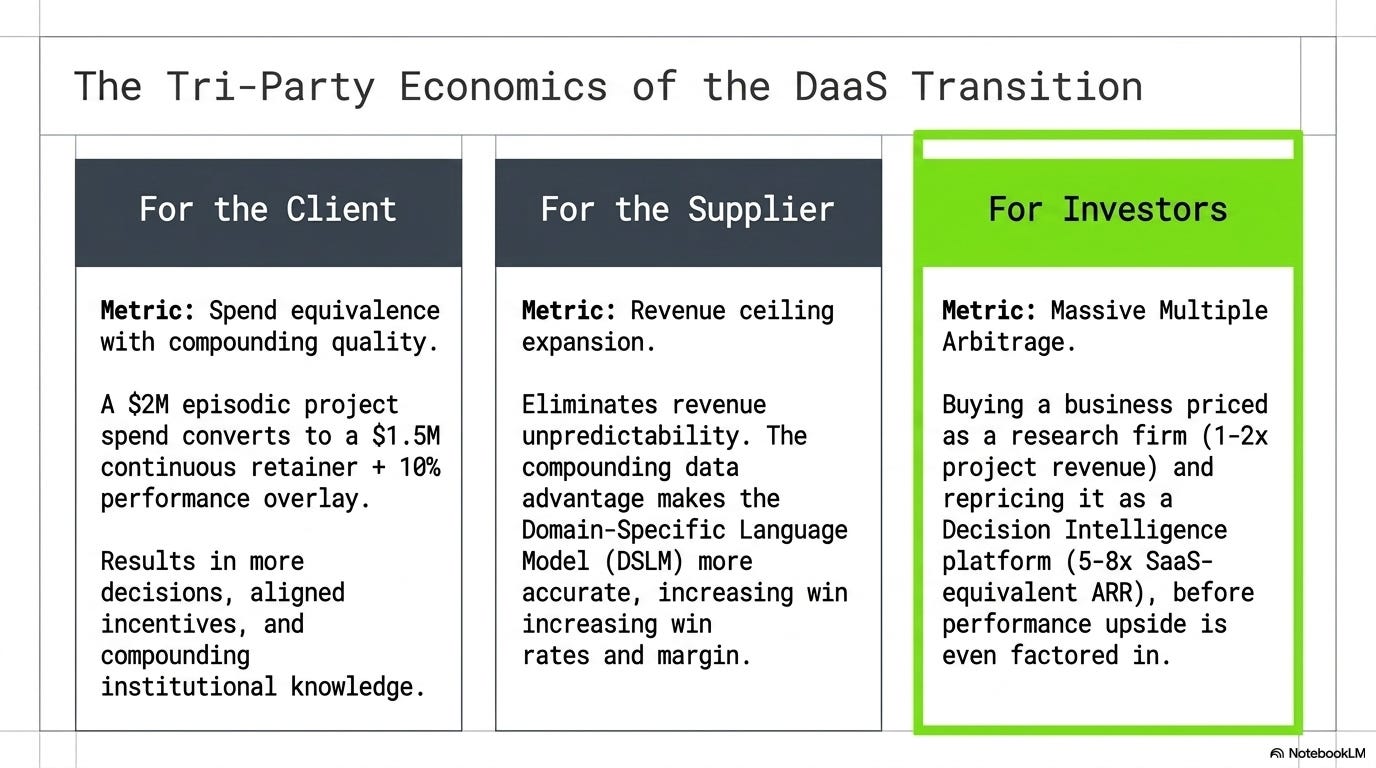
For the client: Consider a major CPG brand spending $2M annually across discrete research projects to inform 8–10 significant brand management decisions. Under a DaaS model with a $1.5M annual retainer and a 10% performance overlay on three major decisions, the total spend is roughly equivalent in baseline — but the decision quality is continuous rather than episodic, the institutional knowledge compounds rather than resetting with each project, and the performance component means the supplier has skin in the game alongside the client. The net result is more decisions, better supported, at equivalent or lower cost, with incentives aligned.
For the supplier: Moving $2M in project-based revenue to $1.5M in ARR eliminates revenue unpredictability, expands valuation multiples from 1–2x revenue (project-based) to 5–8x revenue (SaaS-equivalent ARR), and creates the compounding data advantage that makes the DSLM more accurate over time. The performance overlay adds a revenue ceiling above the base contract that grows as the system improves. The long-run financial model is structurally superior to every prior model in the industry’s history.
For investors: The multiple arbitrage available here — buying a business priced as a research firm and repricing it as a Decision Intelligence platform — is the thesis running through our PE analysis from April. The pricing architecture described above is the commercial mechanism that makes the multiple expansion real rather than aspirational. A firm with $50M in project revenue repricing to $40M in ARR trades at roughly double the multiple before any performance overlay upside is factored in.
The Unanswered Questions Worth Sitting With
Jeff ended his response with: “I haven’t yet figured any of that out but hopefully look forward to exploring with you!”
In that spirit, here are the questions this post does not fully resolve — the ones that will define the next stage of the conversation:
The Attribution Problem at Scale: In a complex brand management environment, multiple DaaS decisions interact. The pricing decision, the media decision, and the innovation decision are interdependent. Who gets credit — and who absorbs the performance fee adjustment — when outcomes are influenced by multiple decisions made under a single DaaS contract?
The Failure Mode Contract: What happens when the confidence-scored recommendation is acted on and the outcome is poor? The investment banking analog is instructive: banks that advise on failed deals still collect retainers. The client absorbs the outcome. The performance fee is simply not triggered. But in high-stakes situations where the DaaS provider’s recommendation was the primary input to a major capital decision, the relationship model needs explicit failure-mode language. This is the legal architecture the industry has not yet built.
The Competitive Dynamics of Calibration Publishing: If calibration track records become the trust standard — which they should — then the firm that publishes first sets the benchmark and creates an accountability standard that incumbents with poorer accuracy will resist. The platform player that builds the independent decision-outcome audit capability (think: a Moody’s for decision quality) captures enormous structural value in the ecosystem. That company does not exist yet.
The Transition Economics for Mid-Market Suppliers: The migration path above is feasible for firms with $50M+ in revenue and deep client relationships. For a $10M research boutique with 20 clients and project-dependent cash flow, the transition economics are more precarious. Stage 1 requires accepting lower near-term revenue for higher long-term ARR — a trade that is hard to make when the business runs on quarterly project billings. The mid-market needs a transition structure that does not require betting the firm on the migration. That structure is one of the more important unsolved problems in the industry’s commercial evolution.
The Closing Frame
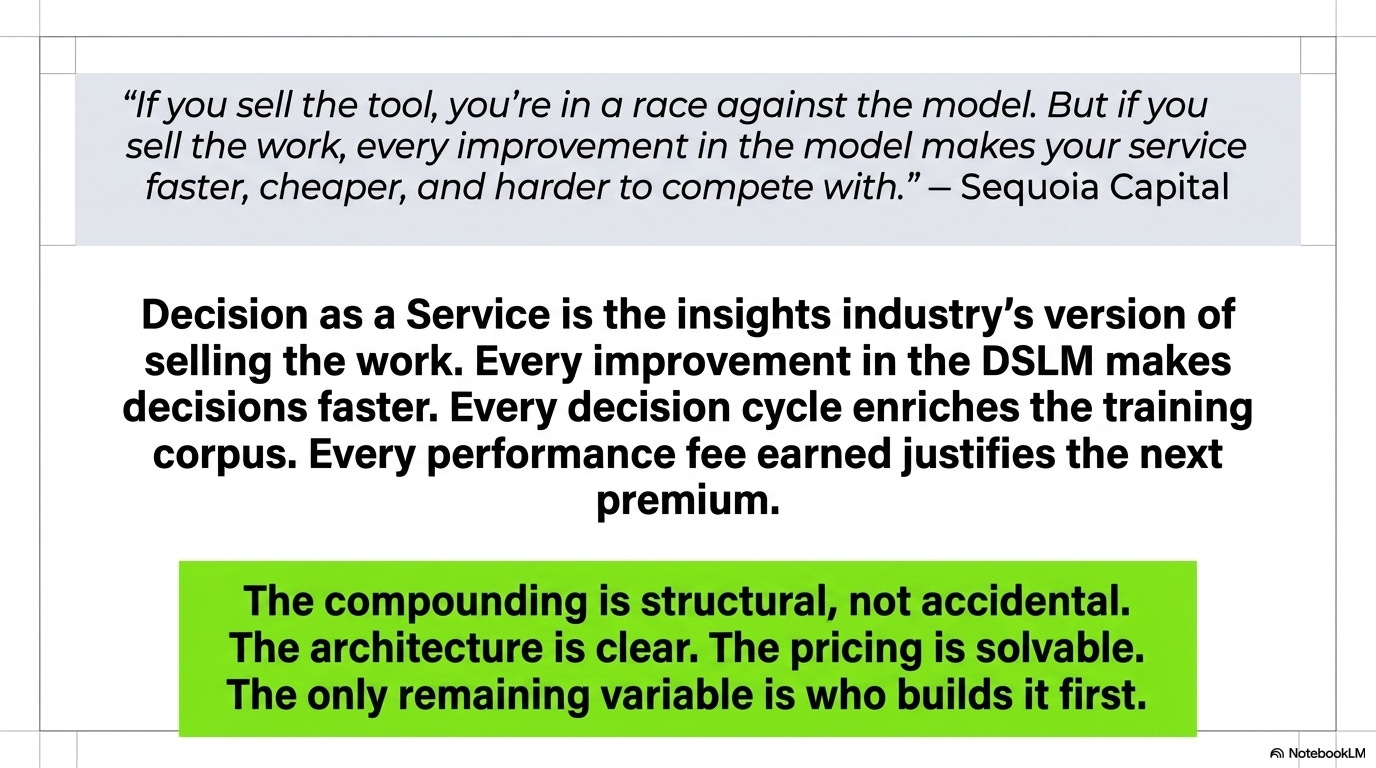
Sequoia’s framing is the right one to close with: “If you sell the tool, you’re in a race against the model. But if you sell the work, every improvement in the model makes your service faster, cheaper, and harder to compete with.”
Decision as a Service is the insights industry’s version of selling the work. Every improvement in the Domain-Specific Language Model makes the decisions faster and better-calibrated. Every additional decision cycle makes the training corpus richer. Every performance fee earned builds the track record that justifies the next client’s willingness to pay the premium. The compounding is structural, not accidental.
The pricing architecture described in this post is not the only way to get there. It is a set of frameworks — drawn from investment banking, AI infrastructure pricing, management consulting, and operational enterprise — that the industry can adapt to its specific context, client relationships, and risk tolerance.
The conversation Jeff started with a text message is, it turns out, a conversation about the most important commercial transformation the insights industry has faced in its 115-year history.
The architecture is clear. The pricing is solvable. What is needed now is the will to act on it before someone outside the industry does it first.
Thanks again to Jeff Krentz and Elaine Riddell for the thinking that shaped this post. Insight Innovation Ventures invests in AI and analytics startups across the USA and UK, with a focus on data infrastructure, research technology, and AI-native insight platforms.
Related reading:
Decision as a Service: The Architecture That Changes Everything — the post that started this thread
The Future of Professional Services Is a Warning Shot for Market Research
Sequoia Capital: Services: The New Software
Mayfield: Cognition-as-a-Service
HelloTwin: The Digital Authority